
Regulated products and creators: the Spain and LatAm rules matrix for alcohol, health, finance, gambling and kids
Regulated products influencer marketing rules for Spain and LatAm: alcohol, supplements, medicines, finance, gambling, vapes and kids' products in one matrix.
In one month, a drinks brand in Sevilla, a fintech in Madrid and a supplement brand in Valencia send briefs to the same micro-creator. All three posts need the same advertising label. After that, the rulebooks split. The gin post needs a moderation message and an adult audience. The fintech post needs a risk warning as prominent as any return it mentions, and the creator must not answer follower questions about the product. The protein post may use only authorised health claims, word for word, and no weight-loss figures.
These are the regulated products in influencer marketing: categories where a sector law, a sector code or a platform policy adds rules on top of the general duty to label advertising. This guide puts the seven groups that matter in Spain into one matrix. For each group it gives the rule source, who is liable, whether you need pre-clearance, how age gating works and what the brief must say. A short LatAm note covers Mexico, Colombia and Argentina.
It is not legal advice: for a specific campaign, ask your lawyer. Several rules below changed recently and more drafts are in progress, so every threshold and status carries the same instruction: verify against the current text on the date you brief.
What makes a product "regulated" in creator marketing?
A product is regulated for advertising when a law, a self-regulatory code or a platform policy sets rules for its ads that go beyond the general rules. In Spain, two layers apply to every sponsored creator post.
Layer 1: the general influencer rules. Every paid or gifted post is a commercial communication and must be clearly identified as advertising. This comes from Ley 3/1991 (art. 26), the LSSI (art. 20) and, for the largest creators, the audiovisual law. The AUTOCONTROL influencer code explains which labels pass and where they go. Our legal checklist for influencer marketing in Spain and the guide to the AUTOCONTROL influencer code (2025 version) cover this layer.
Layer 2: the product rule. Ley 34/1988, General de Publicidad, art. 5.1, allows special rules, and in some cases prior authorisation, for products that can affect health or safety and for gambling. The sector law then sets the limits. A sector code (spirits, wine, toys, food to children) adds detail. The platform policy can be stricter than both.
The two layers meet in the audiovisual law. Ley 13/2022 (LGCA), art. 94.1, says a user of special relevance must respect sections 1 and 2 of chapter IV, title VI, when they market or organise commercial communications. Those sections contain the alcohol, tobacco, medicine, gambling and minors rules (arts. 121 to 124). So a large creator answers for the product rules directly, not only through the brand. Real Decreto 444/2024 sets who counts: EUR 300,000 or more in income, 1 million followers on one platform or 2 million in total, and 24 or more videos a year.
One open point: the LGCA also sets time windows for some audiovisual ads (spirits over 20 degrees only from 1:00 to 5:00, drinks of 20 degrees or less from 20:30 to 5:00, gambling from 1:00 to 5:00, arts. 123.4, 123.5 and 123.7). Art. 94.1 pulls these sections onto large creators on paper. How a time window applies to an on-demand reel is not settled in the texts we read. Ask counsel, and do not assume it does not apply.
The matrix: seven product groups, five questions
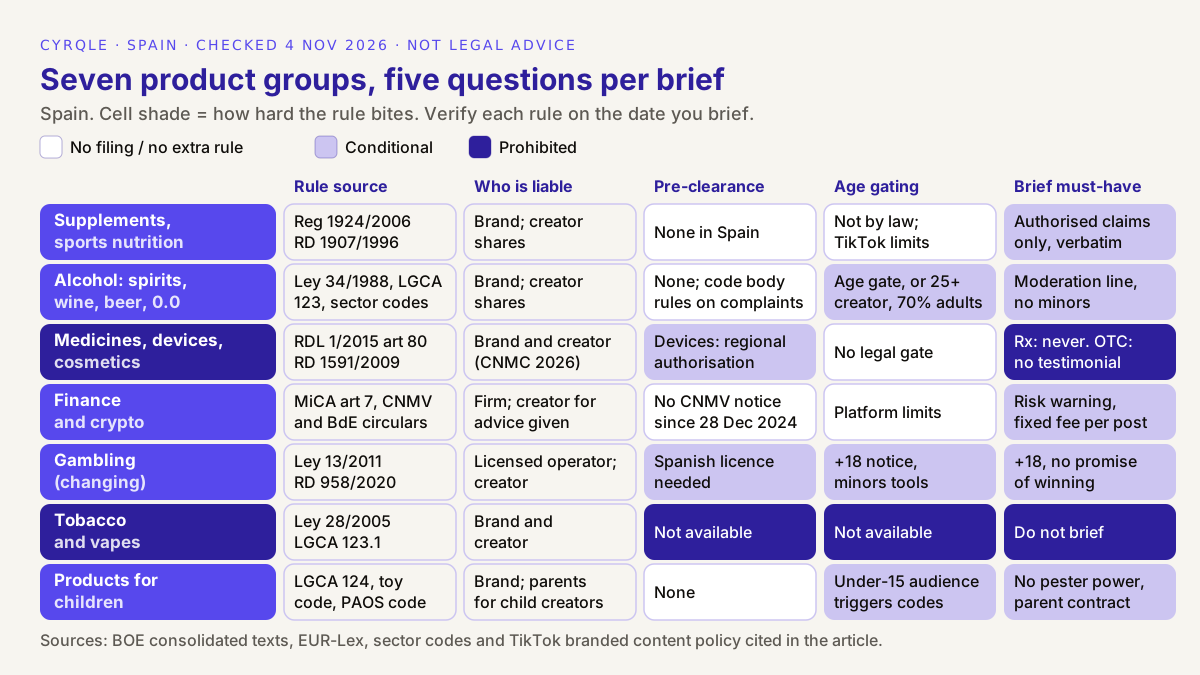
The table holds the same data in text, with a little more detail per cell.
| Product group | Rule source (Spain) | Who is liable | Pre-clearance or pre-notification | Age gating | Brief must-haves |
|---|---|---|---|---|---|
| Food supplements and sports nutrition | Reg. (EC) 1924/2006 on health claims; RD 1907/1996 art. 4 | Brand; creator shares | None found in Spain | Not by law; TikTok limits some supplements | Authorised claims only, verbatim; no cure, slimming or weight-loss figures; no health-professional endorsement |
| Alcohol (spirits, wine, beer, 0.0) | Ley 34/1988 art. 5.5; LGCA art. 123.3 to 123.5; spirits, wine and beer codes | Brand (code member); creator | None; the AUTOCONTROL Jurado rules on complaints | Yes: platform age gate where available, otherwise creator 25+ and audience at least 70% adult (spirits code) | No minors; moderation message; no link to driving, sport, social or sexual success; 0.0 kept separate from the parent brand where alcohol ads are banned |
| Medicines, medical devices, cosmetics | RDL 1/2015 art. 80; RD 1591/2009 art. 38; Reg. (EU) 655/2013 | Brand and creator (CNMC fined a creator in 2026) | Device ads to the public: prior authorisation by the regional health authority | No legal age gate | Prescription: none. OTC medicine: no testimonial, leaflet invitation, "medicine" stated. Cosmetics: substantiated claims, no medical claims |
| Financial products and crypto | MiCA art. 7; CNMV Circular 2/2020; Banco de España Circular 4/2020 | Firm or offeror; creator for unlicensed advice | No CNMV pre-notice for crypto since 28 Dec 2024 | Not by law; platform limits | Risk warning as prominent as any return; fixed fee per piece; disclose holdings; no answers to follower questions on the product |
| Gambling | Ley 13/2011; RD 958/2020 arts. 10, 11 and 26.1; LGCA art. 123.7 | Licensed operator; creator | No filing, but only operators with a Spanish licence may advertise | Yes: +18 notice; only networks with tools to keep ads from minors | +18 warning; responsible-gambling message; no promise of winning; no content that appeals to minors |
| Tobacco and vapes | Ley 28/2005 art. 9 and additional provision 13; LGCA art. 123.1 | Brand and creator | Not available | Not available | Do not brief |
| Products for children | LGCA art. 124; toy advertising code (2022); PAOS code (food and drink to children) | Brand; parents sign for child creators | None | Codes apply when the audience is mainly under 15 (toys) or children (PAOS) | No direct call to buy; no pester power; toys shown truthfully; parental contract for any creator under 18 |
Row by row: what each product group needs
Food supplements and sports nutrition
Health claims on foods must be on the EU list of authorised claims. Reg. (EC) 1924/2006, art. 12, bans claims about the rate or amount of weight loss and claims that refer to the recommendations of individual doctors or health professionals. Reg. (EU) 1169/2011, art. 7.3, bans presenting a food as preventing, treating or curing a disease. Spain adds RD 1907/1996, art. 4: advertising of products with a claimed health purpose may not suggest slimming properties, promise relief or cure, use testimonials of health professionals, famous people or real or supposed patients to induce consumption, or suggest better physical, mental, sport or sexual performance. In December 2025, the AUTOCONTROL Jurado found a food-supplement ad unlawful because it used a famous health professional's testimonial, according to a note by Uría Menéndez.
One tension needs a lawyer: an authorised EU claim, such as caffeine and endurance, can sound like the "better sport performance" message that RD 1907/1996 bans. Brief the authorised wording verbatim and have counsel review it. Our page on creator marketing for fitness and supplements covers the commercial side.
Alcohol: spirits, wine, beer and 0.0
Ley 34/1988, art. 5.5, bans audiovisual commercial communication of drinks over 20 degrees, with the LGCA time-window exception. LGCA art. 123.3 bans alcohol ads aimed at minors or showing minors drinking, links to physical performance, driving or social or sexual success, therapeutic claims, immoderate drinking and alcohol content as a positive quality. It also requires a message of moderate, low-risk consumption.
The spirits sector code (in force since 25 May 2023, text) is the most specific creator rule in any category. Art. 13.2 says creators must use age-verification tools where available, and the gate can apply to the agreed posts only. Where no such tool exists, art. 13.3 allows only creators aged 25 or over whose audience is at least 70% over 18. Art. 13.4 excludes creators linked to abusive drinking, and art. 13.5 recommends a written agreement that covers disclosure, the moderation message and tools to restrict minors. Free product, event tickets and trips count as payment (art. 13.1). Art. 9.7 says 0.0 versions are not for minors and carry "+18" in shareable digital ads.
Wine has an updated sector code with social and influencer rules from 1 January 2026, reported by Wine in Moderation: adult creators, audiences over 70% adult and a visible moderation message. We did not find an influencer-specific rule in the beer code. For 0.0 brand extensions, law firms warn that the parent brand's name can make the ad indirect alcohol advertising in media where alcohol ads are banned.
Medicines, medical devices and cosmetics
These are three different regimes. Do not treat them as one.
- Prescription medicines cannot be advertised to the public. RDL 1/2015, art. 80.1, allows public advertising only of medicines that are not publicly funded, do not need a prescription and are not psychotropic or narcotic.
- Non-prescription (OTC) medicines may be advertised, with no prior authorisation (art. 80.3). The ad must be clearly advertising, say the product is a medicine, name it, and invite the reader to read the leaflet and ask the pharmacist. Art. 80.2.d bans testimonials about the product's virtues and testimonials from professionals or "personas cuya notoriedad pueda inducir al consumo". A paid creator testimonial is exactly that. Art. 80.5 also bans prizes, gifts and contests tied to these medicines. On 18 June 2026 the CNMC fined a user of special relevance for paid posts on Facebook and Instagram that promoted cold and flu medicines as a category, with no brand named. The fine was EUR 1,779.94, reduced to EUR 1,067.96 for admission and early payment (file SNC/DTSA/144/25).
- Medical devices (contact lenses, test kits, monitors) need prior authorisation from the health authority of the comunidad autónoma for ads to the public in any general medium, "incluido Internet" (RD 1591/2009, art. 38.6). Art. 38.8 bans recommendations from scientists, health professionals or people whose fame can encourage use.
- Cosmetics may be advertised with claims that meet the EU common criteria: legal compliance, truthfulness, evidential support, honesty, fairness and informed decision (Reg. (EU) 655/2013). No medical claims. RD 1907/1996 art. 4.11 bans claims beyond what is recognised for cosmetics.
Some parapharmacy products sit on the border between these regimes. Classify the product first, from its label and registration, then pick the row.
Financial products and crypto
For crypto, the old Spanish rule is gone. CNMV Circular 1/2022, which covered influencers and required notice to the CNMV of campaigns aimed at more than 100,000 people, was repealed with effect from 28 December 2024 by CNMV Circular 1/2024, because MiCA now has specific advertising rules. Under MiCA, art. 7, marketing communications must be clearly identifiable, fair, clear and not misleading, consistent with the crypto-asset white paper, and must point to the white paper and the offeror's website. The offeror is responsible for the content.
For investment services, the CNMV draws a line between advertising and client acquisition. According to press reports of its criterion (December 2025), a creator paid a fixed fee per published piece is advertising. A creator paid per client or volume captured, or who answers follower questions about the product, starts to look like client acquisition, which only authorised firms and their agents may do. Investment firms also need a board-approved advertising policy under CNMV Circular 2/2020, and banking products follow Banco de España Circular 4/2020, which has a specific regime for social networks.
Gambling
The ban on public figures in gambling ads is gone. RD 958/2020, art. 15, is annulled in full by the Supreme Court ruling of 2 April 2024, along with parts of arts. 13 and 26. Much of the 2021 to 2023 commentary still applies it to influencers.
What still stands: gambling ads may not target minors directly or indirectly or appeal to them (art. 11.1 and 11.2), must carry an age warning such as "+18" (art. 11.3), and may run on social networks only where the network has tools to keep ads from minors, let users block them and segment the audience (art. 26.1). The LGCA allows gambling ads only from operators with a Spanish licence (art. 123.7). In May 2026 the Ministry of Consumo opened a public consultation on reforming the gambling law, including the presence of famous people and influencers in gambling ads. Treat this row as conditional, high risk and changing.
Tobacco and vapes
Do not brief. Ley 28/2005, art. 9.1, bans tobacco advertising and sponsorship in all media, including information society services. Additional provision 13 extends the ban to commercial communications for nicotine devices and refills in information society services, and art. 19.4 makes unpermitted advertising of these devices a very serious infringement. LGCA art. 123.1 bans audiovisual ads for tobacco, e-cigarettes and refills, and for the companies that make them. TikTok's branded content policy prohibits cigarettes, tobacco and nicotine products, including vapes and tobacco-free alternatives.
Products for children and child creators
LGCA art. 124.1 bans ads that directly invite minors to buy, push them to persuade their parents, exploit their trust in parents, teachers or characters, or promote body cult through slimming products or aesthetic treatments. Toy ads must not mislead on features, safety or skills and must not reproduce sexist stereotypes (art. 124.2). The toy advertising code (in force since 1 December 2022) covers audiences mainly under 15, has an internet section and refers to the influencer code. Food and drink ads to children follow the PAOS code; see the AESAN page for its current status.
When the creator is a minor, AUTOCONTROL's influencer code (norm 8) requires a contract with explicit parental consent, and the minor also signs when mature enough, always between 14 and 18.
What changed recently, and what is still only a draft?
Most pages that rank for these questions are a year or more out of date. Several report drafts as law. This table gives the status we found on 4 November 2026.
| Rule | Status | Date | Source |
|---|---|---|---|
| RD 958/2020 art. 15, ban on public figures in gambling ads | Annulled | Supreme Court, 2 Apr 2024 | BOE |
| CNMV Circular 1/2022, crypto advertising and 10-day pre-notice | Repealed (MiCA applies) | 28 Dec 2024 | BOE |
| Spirits code, influencer article 13 | In force | 25 May 2023 | Sector code |
| Wine code update with influencer rules | In force | 1 Jan 2026 | Wine in Moderation |
| CNMV criterion on influencers and investment services | Published criterion (press reports) | Dec 2025 | Forbes España |
| CNMC fine on a creator for medicine posts | Decided | 18 Jun 2026 | Uría Menéndez |
| TikTok branded content policy (current version) | In force | 30 Oct 2026 | TikTok |
| Medical-device advertising decree (would restrict influencer ads) | Draft | Hearing Feb-Mar 2024 | CNMC report |
| Decree to replace RD 1416/1994 on medicine advertising | Draft | Consultation 2023 | Ministry of Health |
| Decree on food and drink ads to children | Draft | 2022 | AESAN |
| Bill on alcohol and minors | Bill; check parliamentary status | Approved by the Council of Ministers 11 Mar 2025 | Ministry of Health |
| Bill on minors in digital environments | Bill; check parliamentary status | Sent to Congress 25 Mar 2025 | La Moncloa |
| Gambling law reform (influencers, sign-up offers) | Public consultation | From 19 May 2026 | Consumo |
Who is liable: the brand, the agency or the creator?
The brand carries the sector rule, but the creator is not safe. Our guide to who is liable for a creator's post in Spain explains the general split. For regulated products, four points matter.
- The advertiser carries the sector rule. The sector laws are written about the advertiser, and the sector codes bind their members. A brand that signs the spirits code answers to the AUTOCONTROL Jurado for its creators' posts.
- Large creators answer to the CNMC directly. Through LGCA art. 94.1, a user of special relevance must respect the product rules. The June 2026 medicine fine went to the creator, and no brand was named.
- In finance, the regulated firm chooses and controls. The CNMV holds the firm responsible for choosing suitable collaborators and for the content. MiCA makes the offeror responsible for crypto marketing communications. The creator carries the risk of giving advice without a licence.
- The agency's share depends on the contract. Write who drafts the claims, who approves the draft and who corrects a post. The influencer contract template for Spain has the clauses.
Decide in five questions
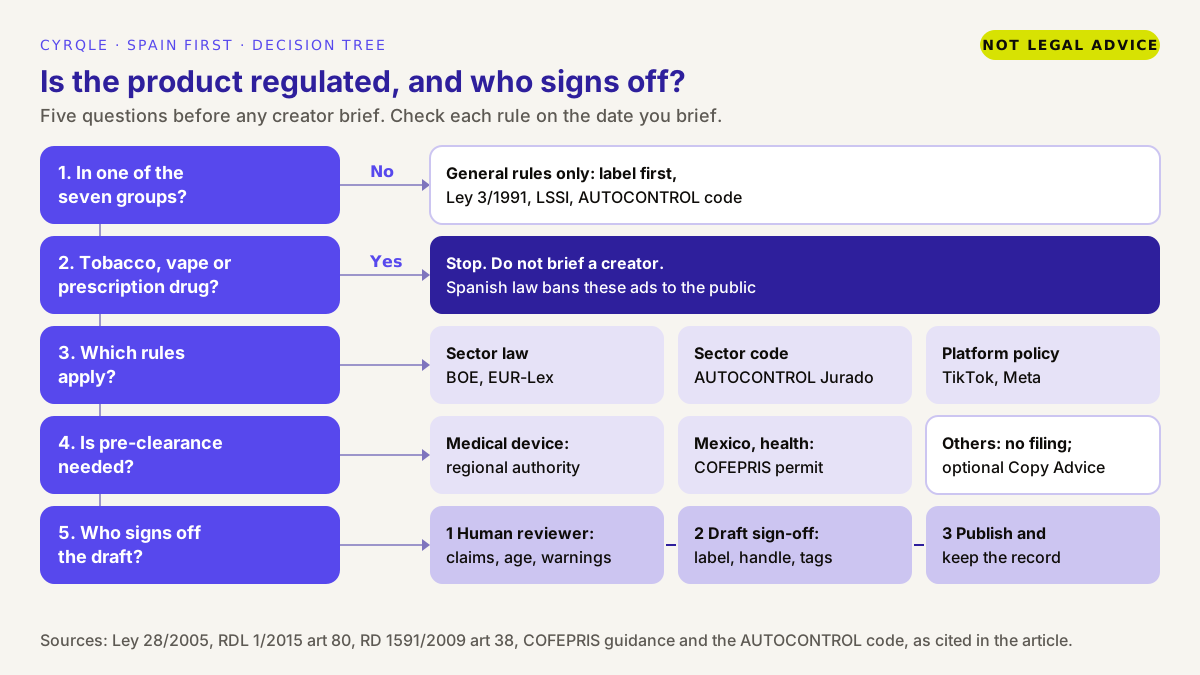
- Is the product in one of the seven groups? If not, the general rules apply: label first, in the language of the post.
- Is it tobacco, a vape or a prescription medicine? If yes, stop. No creator brief.
- Which rules apply? List three sources for the row: the sector law, the sector code (if the brand is a member, or the category has one) and the platform policy.
- Is pre-clearance needed? In Spain, medical-device ads to the public need regional authorisation before you publish. In Mexico, many health products need a COFEPRIS permit. For the other rows there is no filing, but AUTOCONTROL offers a voluntary pre-publication review of the copy (Copy Advice).
- Who signs off the draft? A named person on the brand side, usually legal or regulatory, approves claims, the age gate and the mandatory messages. Then the campaign team checks the label, handle and hashtags. Then the post goes live and the record is kept.
Worked example: one creator, three briefs
The three briefs from the introduction, side by side. The creator and brands are illustrative.
| Gin brand, Sevilla | Fintech app, Madrid | Protein brand, Valencia | |
|---|---|---|---|
| Row | Alcohol (spirits) | Finance (payments and savings) | Supplements and sports nutrition |
| Creator check | 25 or over; no link to excess drinking; audience age insights on file | No unlicensed advice; holdings declared | No health-professional title used in the post |
| Pre-clearance | None | None for advertising; check the firm's advertising policy | None |
| Age gating | Platform minimum age 18+ set before posting | Not by law | Not by law |
| Mandatory messages | Moderation message; "+18" | Risk warning as prominent as any return | None; authorised claim wording only |
| Pay structure | Fixed fee or product | Fixed fee per piece; no pay per sign-up | Any model |
| Banned in the brief | Party, sport or driving scenes; minors in frame | Return promises; answering DMs about the product | Weight-loss figures; "cures", "detox" health claims |
The same label rule covers all three. Everything else in the table comes from the row.
LatAm in one paragraph per market
The Spanish matrix does not travel. Use our guide to influencer advertising rules in Mexico, Colombia, Argentina and Chile for labels and liability; the product points below are the ones that most often change a brief.
- Mexico. COFEPRIS published an influencer guide in September 2024 (reported by Expansión) that covers health services, food, supplements, alcohol and tobacco. Creators should check that the product has a COFEPRIS advertising permit where one is required and show the mandatory legends. For vapes, a constitutional reform (January 2025) and a reform of the Ley General de Salud (December 2025) ban production, sale and advertising; sources differ on the start date, so check the DOF.
- Colombia. Ley 1335 de 2009 bans tobacco advertising, and Ley 2354 de 2024 extends rules to vaping devices, with an advertising ban reported from May 2025 (Baker McKenzie). The SIC influencer guide covers disclosure.
- Argentina. Ley 26.687 bans tobacco advertising by any medium, with exceptions. Alcohol, finance and online gambling (regulated by province) need local advice.
Before any regulated post goes live
Run this list on every draft in a regulated row. The fuller logging routine is in our influencer campaign compliance audit.
How cyrqle helps
cyrqle does not clear claims, file with regulators or decide whether a product can be advertised. That stays with your legal or regulatory reviewer. What it does is put the row's rules into the campaign so they are written down and checked at the right step. In Campaigns:
- Brief. Write the row's must-haves on the Brief tab: approved claims, banned words, the age-gate instruction, the mandatory message and the required hashtags. Our creator brief template has space for each.
- Contract. Each creator signs the Creator Collaboration Agreement by two-sided e-signature, with a frozen terms snapshot and the IP address, device and time recorded. Link your brand terms to add the duty to comply and to correct a post, as the spirits code recommends.
- Draft sign-off. With draft approval on, you approve each draft or request changes. An automated check flags a missing disclosure tag or brand handle (both block approval) and missing campaign hashtags (a warning). For Spain the check accepts "#publicidad" or "#ad", and the AUTOCONTROL code rejects "#ad" in a Spanish post, so add "#publicidad" as a required hashtag. The check does not review claims, age gates, warnings, legends or minors in frame. A person does.
- Record. Published Instagram and TikTok posts are tracked with the same compliance verdict, and the Campaign report keeps drafts and posts together for the audit. Stories are not tracked automatically.
Before you invite anyone, Find creators shows each creator's brand-collaboration history (paid partnerships and tagged brands), so you can review whether they have promoted a competing or risky category. It cannot verify audience age, so ask the creator for their platform insights. To see this on your own category, book a walkthrough.
In this cluster
Each row has a deeper guide in this series:
FAQ
Can influencers advertise alcohol in Spain?
Yes, with limits. The spirits code requires the platform's age gate where available; otherwise only creators aged 25 or over with an audience at least 70% adult. The post needs a moderation message, no minors and no links to driving, sport or social success. Large creators may also fall under the LGCA time windows, so ask counsel.
Can an influencer promote betting or a casino in Spain?
Only for an operator with a Spanish licence, with a "+18" warning, no appeal to minors and only on networks that can keep the ad from minors. The 2020 decree's ban on public figures was annulled in April 2024, but a reform of the gambling law that covers influencers is under consultation.
Can influencers promote medicines or medical devices?
Prescription medicines: no. Non-prescription medicines: an ad is allowed, but not a testimonial from a person whose fame can drive sales, and the CNMC fined a creator for medicine posts in 2026. Medical-device ads to the public need prior authorisation from the regional health authority and may not use a well-known person's recommendation.
Do crypto campaigns with influencers still need to be notified to the CNMV?
Not under the old rule. CNMV Circular 1/2022 and its 10-business-day notice were repealed with effect from 28 December 2024. MiCA's rules on marketing communications apply instead: clearly identifiable, fair, clear, not misleading and consistent with the white paper.
Who is responsible if a creator breaks a product rule: the brand or the creator?
Both can be. The brand carries the sector law and its code membership. A large creator answers to the CNMC under the audiovisual law. Keep the brief, the contract and the written draft approval as your record.
Can influencers promote vapes in Spain?
No. Ley 28/2005 bans commercial communications for nicotine devices and refills in information society services, and TikTok's branded content policy prohibits vapes. Instagram announced in 2019 that it no longer allows branded content for vapes and tobacco; check Meta's current policy before any nicotine-adjacent brief.
Sources
- Ley 13/2022, General de Comunicación Audiovisual, arts. 94, 122, 123 and 124: https://www.boe.es/buscar/act.php?id=BOE-A-2022-11311
- Ley 34/1988, General de Publicidad, art. 5: https://www.boe.es/buscar/act.php?id=BOE-A-1988-26156
- Real Decreto 444/2024: https://www.boe.es/eli/es/rd/2024/04/30/444
- Real Decreto 1907/1996 (health-purpose advertising): https://www.boe.es/buscar/act.php?id=BOE-A-1996-18085
- Regulation (EC) 1924/2006 (health claims): https://eur-lex.europa.eu/eli/reg/2006/1924/oj
- Real Decreto Legislativo 1/2015 (medicines), art. 80: https://www.boe.es/buscar/act.php?id=BOE-A-2015-8343
- Real Decreto 1591/2009 (medical devices), art. 38: https://www.boe.es/buscar/act.php?id=BOE-A-2009-17606
- Regulation (EU) 655/2013 (cosmetic claims): https://eur-lex.europa.eu/eli/reg/2013/655/oj
- Regulation (EU) 2023/1114 (MiCA): https://eur-lex.europa.eu/eli/reg/2023/1114/oj
- CNMV Circular 1/2022 (repealed) and Circular 1/2024: https://www.boe.es/buscar/act.php?id=BOE-A-2022-666 and https://www.boe.es/buscar/act.php?id=BOE-A-2024-27149
- Real Decreto 958/2020 (gambling advertising), consolidated: https://www.boe.es/buscar/act.php?id=BOE-A-2020-13495
- Ley 28/2005 (tobacco): https://www.boe.es/buscar/act.php?id=BOE-A-2005-21261
- Código de Autorregulación Publicitaria de Espirituosos España (2023): https://newsletters.anunciantes.com/legalfebrero2024/assets/codigo-autorregulacion-publicidad-espirituosos.pdf
- TikTok Branded Content Policy: https://www.tiktok.com/legal/page/global/bc-policy/en
Related field notes.
Influencer regulation in Latin America: what PROFECO, SIC, CONARP and SERNAC expect, the label each market wants and one caption that fits all four.
Where regulators are this spring across Spain, France, Brazil, Mexico, and the UK. What changed in Q2, what's coming in Q3, and what to enforce at the brief layer.
TikTok influencer marketing in Spain, step by step: brief a sound-on video, shortlist on views per follower, sign Spark codes, add Publi, check effective CPM.