
Paying creators on behalf of clients: an agency guide
An agency paying influencers on behalf of a client must settle who funds, who invoices, who withholds IRPF and how its fee shows. Worked EUR 1,000 payout split.
When an agency pays influencers on behalf of a client, four questions decide the whole set-up: who funds the creator fees, who receives the creator's invoice, who withholds income tax, and how the agency fee is shown to the client. Answer them in the client contract before the first creator is booked, not at month end when finance asks why EUR 869.20 left the agency's bank.
Picture a Madrid agency that runs creators for three client brands: a cosmetics label in Valencia, a sports retailer in Seville and a restaurant group in Barcelona. Each client wants the agency to "handle the creators, payments included". That sentence can mean two very different legal and tax arrangements, and the agency's turnover, cash position and filing duties change with it.
This guide is for agency founders, account directors and finance leads in Spain. It explains the two structures, shows who invoices and who withholds in each, sets out how to present the agency fee, and works one EUR 1,000 payout through to the last euro. It is not legal or tax advice: Spanish tax rulings answer specific cases, so confirm your structure with your gestor or tax adviser. For the brand-side rules on invoices, IRPF and IVA, start with how to pay influencers in Spain.
Are you buying in your own name or paying for the client?
An agency that pays creators for a client works in one of two structures. Spanish tax law treats them differently, so pick one per client and write it into the contract.
Structure A: the agency buys and resells. The agency contracts the creator in its own name, receives the creator's invoice, pays it, and invoices the client for the creator's work plus its fee. For IVA, Article 11.Dos.15º of Ley 37/1992 says that a mediator acting in its own name in a supply of services is treated as having received and supplied the service itself. In practice, the creator's fee becomes agency revenue, and the agency invoices the full amount with 21% IVA.
Structure B: the agency acts in the client's name. The creator contracts with the client and invoices the client. The agency arranges the work and, if it moves the money, pays the creator in the client's name and on the client's behalf. Article 78.Tres.3º of the same law excludes from the agency's IVA base "las sumas pagadas en nombre y por cuenta del cliente en virtud de mandato expreso del mismo", the amounts known as suplidos. Three conditions come with it: an express mandate from the client, proof of the actual amount, and no deduction of any IVA charged on those amounts. The agency invoices only its own fee, with IVA.
A third arrangement removes the agency from the money path: the client funds a campaign account on a payout platform, and creators are paid from it. The contracts and invoices still follow structure B, but the agency never holds client money.
| Agency buys and resells (A) | Agency pays in the client's name (B) | Client funds a platform wallet | |
|---|---|---|---|
| Who signs with the creator | The agency | The client (the agency can sign as its representative) | The client, usually with the agency operating the campaign |
| Creator invoices | The agency | The client | The client |
| Money passes through the agency's bank | Yes, all of it | Yes, as suplidos | No |
| Agency invoices the client for | Creator fee plus agency fee, all with 21% IVA | Agency fee with IVA; suplidos listed without IVA | Agency fee only |
| Who withholds IRPF (Spanish creator) | The agency, as payer | Confirm with your adviser | Confirm with your adviser |
| Agency turnover on a EUR 1,000 payout | EUR 1,000 | EUR 100 | EUR 100 |
| Credit risk if the client pays late | The agency's | The agency's, if it pays before it is funded | None for the agency |
| Best fit | Net pricing, one price per deliverable | Transparent pricing with agency-run payments | Transparent or net pricing, many creators |
Checked on 30 September 2026 against the consolidated text of Ley 37/1992 on the BOE. Structure A is not wrong. It suits agencies that sell a package at one price. It does mean higher reported turnover, more IVA cash flow, and full exposure if the client pays late.
Who funds the creator fees?
The client should fund the creator budget before the creators deliver. The usual mistake is the reverse: the agency pays creators on delivery, invoices the client at month end, and waits 60 days for payment. On a EUR 40,000 month of creator fees, that is EUR 40,000 of the agency's cash sitting in the client's accounts payable.
Write three things into the client contract:
- A funding schedule. For example, 100% of the creator budget for a campaign before invites go out, or 50% at brief approval and 50% before the first payout.
- What happens to unspent funds. A creator drops out, a deliverable is cancelled. Say whether the balance rolls over to the next campaign or goes back to the client, and when.
- Who approves each payout. The person who releases a payout should check the deliverable against the brief first. Name the role: the account lead, the client's marketing manager, or both above a threshold.
If you use structure B and the agency's own bank account, add the express mandate that Article 78.Tres.3º needs. One clause is enough: the client authorises the agency to pay the named creators, in the client's name and on its behalf, against the creators' invoices addressed to the client.
Who invoices whom?
The invoice chain follows the structure. Get it wrong and the client cannot deduct the IVA, or the agency reports revenue it never earned.
| Step | Structure A (agency buys and resells) | Structure B or platform wallet (agency acts for the client) |
|---|---|---|
| Creator invoices | The agency, for the creator fee + 21% IVA − IRPF | The client, for the creator fee + 21% IVA − IRPF |
| Agency invoices the client | Creator fee + agency fee, + 21% IVA on the total | Agency fee + 21% IVA. Suplidos, if any, listed without IVA |
| Client deducts IVA from | The agency's invoice | The creator's invoice and the agency's invoice |
| Agency must keep | The creator's invoice and its own sales invoice | The mandate, the creator's invoice to the client, and proof of each payment |
Two practical points help.
Invoices addressed to the client carry the client's legal name and NIF. Under Structure B, a creator invoice addressed to the agency is the most common error, and it breaks the suplidos treatment. Put the client's billing details in the brief you send to creators.
The agency can prepare invoices for creators, but only with an agreement. Article 5 of the invoicing regulation, Real Decreto 1619/2012, lets the recipient or a third party issue an invoice in the supplier's name. It needs a prior written agreement with the creator, a procedure by which the creator accepts each invoice, and a copy sent to the creator. The creator stays responsible for the invoice. For the fields every creator invoice needs, use the influencer invoice checklist for Spanish brands.
Who withholds IRPF when an agency pays?
In Spain, the payer of a professional's income withholds. Real Decreto 439/2007 (Article 76) makes companies and businesses that pay income subject to withholding responsible for withholding it. Article 95 sets 15% for professional activities, or 7% for a creator in their first years who notifies the payer in writing. The withholder pays it to the Agencia Tributaria in the quarterly Modelo 111.
- Structure A. The agency pays the creator for a service the agency bought, so the agency withholds, files Modelo 111 and reports the creator in the annual Modelo 190.
- Structure B and the platform wallet. The creator's income comes from the client, and the agency or platform moves the money for the client. Whether the client or the agency must act as withholder is a legal question we could not find answered by a published Dirección General de Tributos ruling for this exact case. A common arrangement is for the client to withhold and file, with the agency preparing the figures, but that is a choice to confirm, not a rule. Agree it with your adviser and write the answer into the contract, because the Agencia Tributaria can claim unpaid withholding from the party that had the duty.
Two rules hold in every structure:
- The withholding base is the creator's fee, not the campaign budget. If a client pays EUR 1,000 and EUR 180 of it is the agency fee and platform commission, the 15% applies to the creator's EUR 820, not to EUR 1,000.
- Withholding depends on the creator, not on you. A creator invoicing through a Spanish company usually gets no IRPF withholding. A creator outside Spain falls under non-resident tax and the reverse charge for IVA. Paying creators in other countries covers the EU, the UK and Latin America.
Collect each creator's tax status at contract stage: autónomo or company, IAE heading, country of residence, any 7% notice, and a tax residence certificate for creators abroad.
How should the agency fee appear?
Show the agency fee as its own line in the money record, even when the client sees only a gross figure. What the client sees is a commercial choice that your contract decides. What your finance team records cannot be a choice.
| Presentation | What the client sees | When it fits | What to watch |
|---|---|---|---|
| Transparent | Creator fee, agency fee and platform cost, each itemised | Clients with procurement teams or audit rights | The client can compare your fee with other agencies line by line |
| Net (hidden) | One gross price per creator or per campaign | Package pricing, small clients, one price per deliverable | If the contract promises cost transparency, a hidden fee breaches it |
| Margin built into the rate | A creator rate with the agency margin already included | Long-running ambassador programmes at set rates | The creator never sees the margin; make sure the creator's own invoice still matches what they receive |
Three rules keep any of these honest:
- Put the presentation in the client contract. "Fees itemised in every report" or "one price per deliverable, agency margin not itemised". Then both sides know what the report will show.
- Invoice the agency fee with IVA. A Spanish agency charges 21% IVA on its fee to a Spanish client, whatever the presentation.
- Keep the full split internally. Creator net, platform commission, agency fee and withholding, per payout. That is what you reconcile at month end, and what you show if a client exercises an audit right.
How large the fee should be is a separate question. How agencies price influencer services compares retainer, percentage of spend and performance fees.
Worked example: one EUR 1,000 creator payout
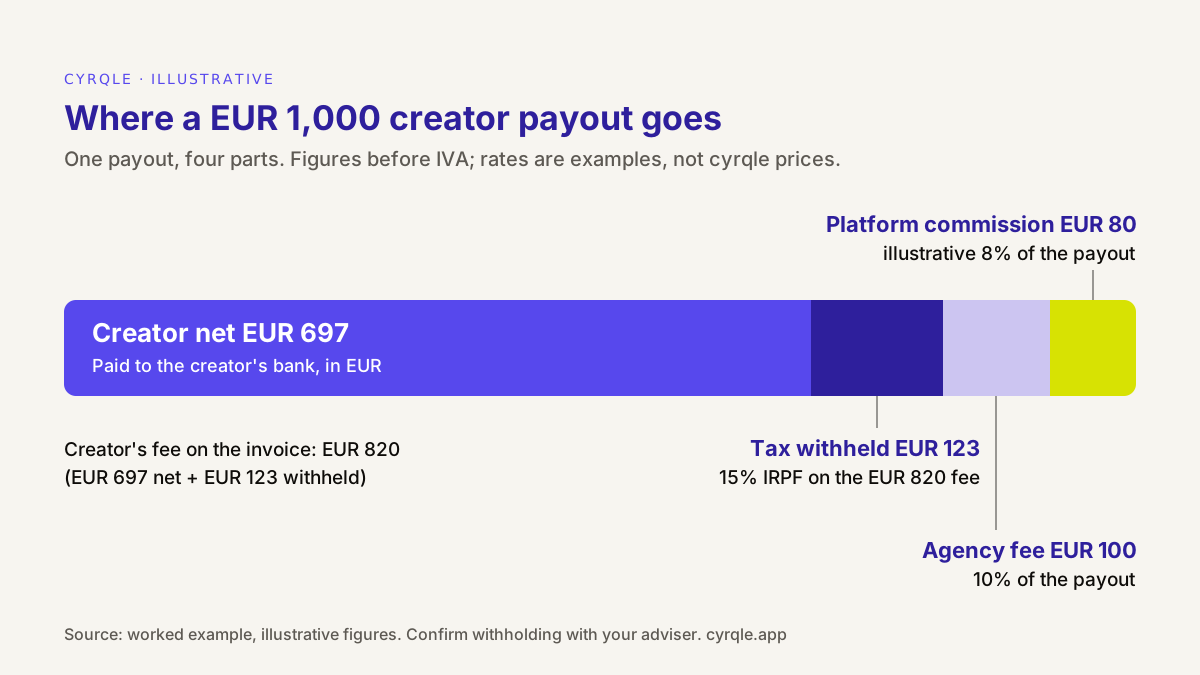
Take one creator payout of EUR 1,000, funded by the client, for two reels by a Spanish autónomo who invoices as a professional at 15% IRPF. All figures are illustrative. The 8% platform commission is an example, not a cyrqle price, and the 10% agency fee is an example of one client's terms.
| Line | Amount | Who receives it | Document |
|---|---|---|---|
| Client funds the payout | EUR 1,000 | Campaign wallet | Funding record |
| Platform commission (illustrative 8%) | EUR 80 | The platform | Platform's statement |
| Agency fee (10%) | EUR 100 | The agency | Agency invoice: 100 + 21 IVA = EUR 121 |
| Creator's fee | EUR 820 | The creator | Creator invoice to the client |
| IRPF withheld (15% of 820) | EUR 123 | Agencia Tributaria, via the withholder's Modelo 111 | Withholding return |
| Creator net | EUR 697 | The creator's bank | Payout statement |
The split does not include IVA. The creator's invoice adds 21% IVA on EUR 820, which is EUR 172.20, so the invoice total is 820 + 172.20 − 123 = EUR 869.20. The client owes that IVA on top of the EUR 1,000 and deducts it in its Modelo 303 if it can deduct IVA in full. Agree how the IVA amount reaches the creator before the first payout: as a separate transfer, or funded into the same budget.
Now the same deal under structure A. The creator invoices the agency EUR 820 + 172.20 IVA − 123 IRPF. The agency pays the creator EUR 869.20, pays EUR 123 to the Agencia Tributaria, and invoices the client EUR 1,000 + 210 IVA = EUR 1,210 (assuming the platform cost is passed through inside the price). The agency reports EUR 1,000 of revenue instead of EUR 100 and has EUR 1,210 outstanding until the client pays. Neither structure changes the client's net cost. Both change who carries the cash and the filings. To see every cost line around a deal, including commission and product, read the true cost of a creator collaboration.
The agency payout checklist
- Contract with the client: structure (A or B), funding schedule, unspent funds, who approves payouts, who withholds, fee presentation, and the express mandate if you pay in the client's name.
- Brief to creators: whose name goes on the invoice, with legal name and NIF, and the payment terms.
- Creator onboarding: tax status, IAE heading, any 7% notice, tax residence certificate for creators abroad, and bank or payout account in the creator's name.
- Before invites: the client has funded the budget, or the agreed share of it.
- At delivery: the deliverable matches the brief; the approver named in the contract signs off.
- Before payout: the invoice is addressed to the right party, the withholding line matches the creator's status, and the split is right.
- After payout: the withholder files Modelo 111 or 216; the agency invoices its fee; finance matches each payout statement to the creator invoice and the agency invoice.
How cyrqle helps
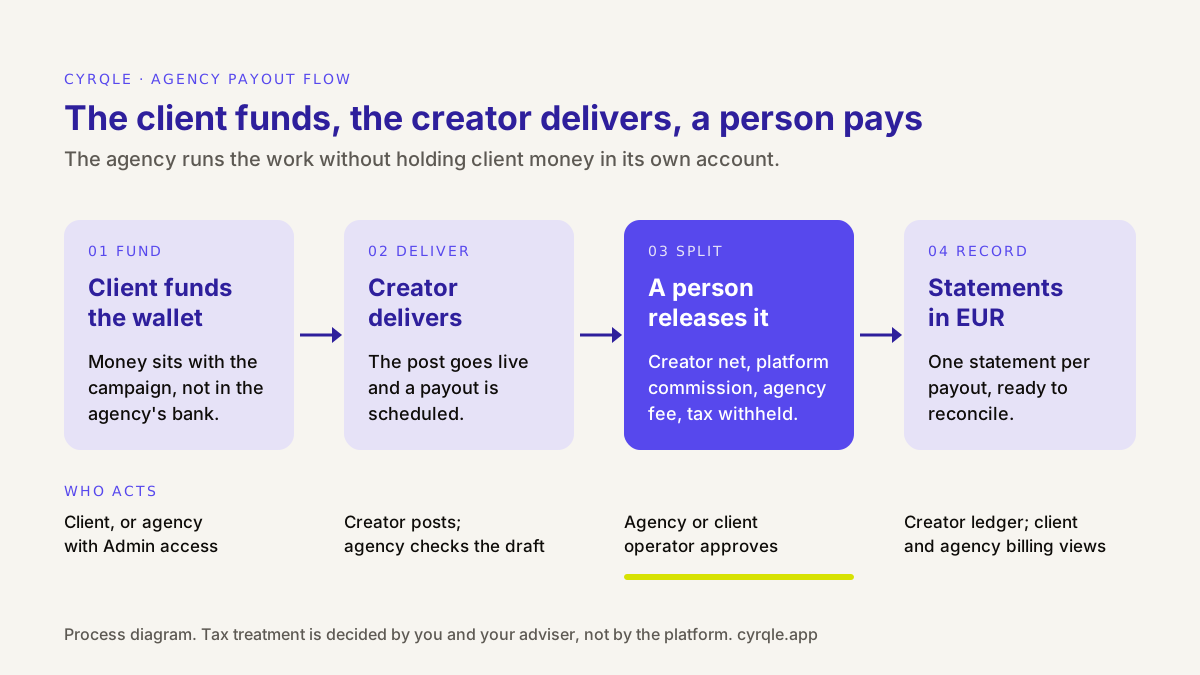
cyrqle is built for the third arrangement: the client funds, the agency runs the work, and the money does not pass through the agency's bank account. It records the split on each payout. It does not decide your tax treatment, collect tax forms or file returns. That stays with your finance team and your adviser.
- One workspace per client. From cyrqle for agencies, you link each client brand, choose Read, Editor or Admin access, and use Act As to work inside the client's workspace. Funding a campaign or sending a contract needs Admin. Managing client brands as an agency walks through the set-up.
- The client funds the campaign wallet. In compensation and contracts, you set the deal terms in the brief (Cash payment, Commission on every sale, Product gift, or a combination) and invites stay blocked until compensation is complete. The client's money funds the campaign; cyrqle schedules a payout when a creator delivers.
- A person releases every payout. Settlement is not automatic. The approver checks the deliverable, then releases the payout.
- A four-way split per payout. Each payout records creator net, cyrqle commission, agency fee and tax withheld, with a statement or invoice per payout. If your agency has its own connected Stripe account, the agency fee on each payout is transferred to it.
- EUR settlement through Stripe Connect. Creators in Europe and the US are paid to their bank through Stripe Connect, in euros; the Stripe integration explains onboarding. For creators elsewhere, the brand pays by bank transfer and records it.
- Fee presentation per client. On a client campaign with agency terms, the agency margin card shows Hidden mode, Transparent or Margin applied, and only agency operators see it. You can hide creator fees from client reports for a whole campaign or for one creator, and your internal payout view still shows the full fee. In agency Billing, Client money rolls up funded, fee, net, paid out, commission and wallet balance per client.
Honest limits: settlement is EUR only, rev-share commission owed is calculated and shown in reports but paid as a separate step, and cyrqle does not remit withholding or file Modelo 111. Agency plans are a custom monthly base plus usage; the pricing page explains the structure. To see the split on your own client terms, book a 30-minute agency demo.
FAQ
Can an agency pay influencers on behalf of a client?
Yes. The agency either buys the creator's work in its own name and resells it, or pays in the client's name under an express mandate. In the first case the creator invoices the agency and the full amount is agency revenue. In the second, the creator invoices the client and the agency invoices only its fee. Write the choice into the client contract before the first payout.
Who withholds IRPF when an agency pays a creator for a client?
The payer of the creator's income withholds. If the agency buys in its own name, the agency withholds 15% (or 7%) and files Modelo 111. If the agency pays in the client's name, or the client funds a platform wallet, confirm with your adviser whether the client or the agency is the withholder, and put the answer in the contract.
Should creator fees go through the agency's bank account?
Only if you choose to resell, or you have an express mandate and keep proof of each payment as suplidos. Otherwise, have the client fund the creator budget directly, for example into a campaign wallet. The agency then carries no credit risk, and its turnover reflects its fee rather than the creators' fees.
Does the agency charge IVA on creator fees it passes through?
It depends on the structure. When the agency resells in its own name, it charges 21% IVA on the full amount, creator fee included. When it pays as suplidos in the client's name, those amounts stay out of its IVA base and it charges IVA only on its own fee. It also cannot deduct IVA on the suplidos.
Can the client see the agency fee?
Only if your contract says so. Agencies use transparent pricing, a net price per deliverable, or a margin built into the creator rate. Whatever the client sees, record the full split internally per payout. If the contract promises cost transparency or audit rights, a hidden fee does not remove that obligation.
Sources
- Ley 37/1992, del Impuesto sobre el Valor Añadido (Articles 11.Dos.15º and 78.Tres.3º): BOE-A-1992-28740
- Real Decreto 439/2007, Reglamento del IRPF (Articles 76 and 95): BOE-A-2007-6820
- Real Decreto 1619/2012, Reglamento de facturación (Article 5): BOE-A-2012-14696
- Agencia Tributaria, Modelo 111
Related field notes.
The cost of an influencer collaboration in Spain, worked in euros: fee, commission, product, IRPF withholding, IVA, and payment, platform and agency fees.
How to pay international influencers from Spain: invoice and withholding by creator country, payment rails and bank fees, who pays FX, and where Stripe works.
How to pay influencers in Spain as a brand: what the invoice must show, when you withhold IRPF, how IVA works for EU and non-EU creators, and gifted products.