
Creator promo codes for Black Friday: naming, limits and leakage
Influencer discount codes for Black Friday: how to name them, cap and expire them, decide on stacking, stop coupon-site leakage and pair codes with links.
Influencer discount codes for Black Friday work when each creator has a unique code for this campaign, the code has an end date and a one-per-customer limit, it gives buyers a reason to type it on top of your sitewide sale, and it travels with a tracking link. Name codes so they are easy to read and hard to guess. Watch redemptions for coupon-site leakage, and pay commission only on the orders you can defend.
Picture a fashion brand in Bilbao with twelve creators for Black Friday week. The site runs 20% off everything. Each creator has a code for 20% off. On Saturday the dashboard shows 240 code orders and the team relaxes. Two problems hide in that number. First, the code gives nothing the sitewide price does not already give, so most buyers who came from a creator never typed it. Second, by Sunday three of the codes are on voucher sites, and loyal customers are using them on orders they were going to place anyway.
This guide fixes both. It covers naming, limits and expiry, stacking with sitewide sales, leakage, and how links recover the sales codes cannot see. It sits inside the 12-week Black Friday creator timeline at week 9, the week you mint codes and test them before your store freezes changes.
Why does every creator need their own code?
Every creator needs a unique code because a code is only evidence if it points to one person. A shared campaign code such as BLACKFRIDAY tells you that a sale came from "the campaign" or from a coupon site, and you cannot tell which. With one code per creator, each redemption is attribution by promo code: the code on the order names the creator, on any device, with or without cookies, online or at the till.
Make the code unique per campaign too. If MARTA works for spring, summer and Black Friday, you cannot separate the seasons in your reports, and a code from March can still give a discount in November. Issue a new code for each campaign and end the old one.
One code per creator per campaign is also what makes commission fair. If two creators share a code, one of them is paid for the other's audience. If a creator's code from the summer sale is still live, you pay commission on sales from a campaign that ended months ago.
How should you name creator promo codes?
Name codes so that a buyer can read them off a phone screen and type them correctly, and so that a stranger cannot guess them. Five rules cover most cases:
- Creator plus campaign. MARTA-BF26 says who and when. A report sorted by code then reads like a creator list.
- No discount in the name. MARTA20 locks you into 20%. If you change the offer, the name lies. Numbers like 20 or 30 also make the code look like a generic deal, and generic deals get collected.
- No generic words. BLACKFRIDAY, BF, CYBER, SALE and WELCOME are the first codes deal hunters and checkout browser extensions try.
- No look-alike characters. Zero and the letter O, one and the letters I and L, get misread in video captions and by staff at a till. Leave them out of any code a person reads aloud or retypes.
- Short enough to type, long enough to be unique. Uppercase letters, digits and one or two hyphens. No spaces, no accents, no special characters. Some stores treat codes as case-insensitive and some tools do not, so keep them uppercase everywhere.
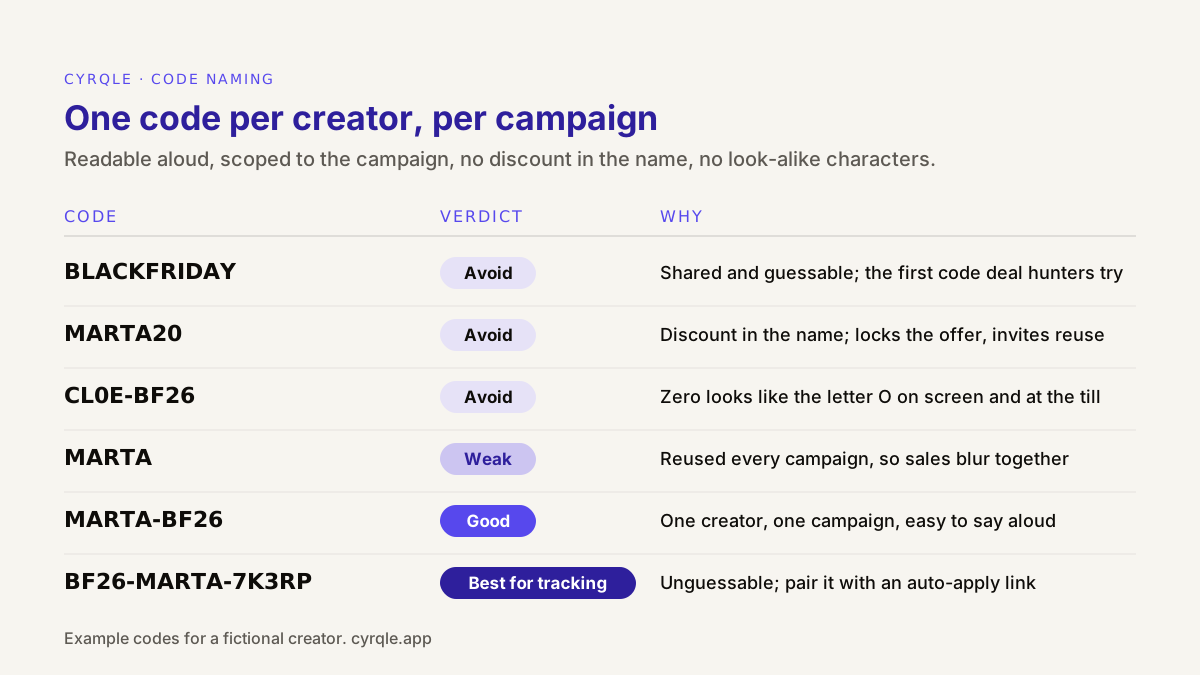
There is a trade-off between readable and unguessable. MARTA-BF26 is easy to say in a reel, but someone who sees one creator's code can guess the pattern for the rest. BF26-MARTA-7K3RP cannot be guessed, but nobody will remember it from a video. The practical answer: use readable codes where the code is spoken or shown on screen, and random suffixes where the code travels inside a link that applies it automatically. In both cases, give the code an end date, so a guessed or leaked code has a short life.
What limits and expiry should a Black Friday code have?
A Black Friday creator code should have a start date, an end date, a one-use-per-customer limit and a clear scope. A total usage cap is optional. Set these in your store's discount settings, not only in the creator brief, because the store enforces them and the brief does not.
| Setting | Recommended for Black Friday | Why |
|---|---|---|
| Start date | The day of the creator's first post, or the early-access date | A code that works before the post leaks before the launch |
| End date | Shortly after Cyber Monday (for example 2 December 2026) | A leaked code stops working when the campaign ends |
| One use per customer | On | Stops one buyer from placing several discounted orders |
| Total usage cap | Optional; set it well above expected demand | Limits damage from a leak, but can cut off real demand at the peak |
| Scope | All products, or the campaign collection | Keep it simple; a code that fails on the hero product loses the sale |
| Combinations | Decided in advance (next section) | Controls whether the code stacks with your sitewide offer |
Shopify supports each of these settings: "Limit number of times this discount can be used in total", "Limit to one per customer" (tracked by email or phone number), active dates, and an end date. Start and end times follow the time zone set in your Shopify admin, so check it if you sell in Spain and Mexico from one store (Shopify Help Center, amount off discounts).
Be careful with total usage caps. A cap of 50 redemptions on a creator who sells 300 orders on Black Friday turns away 250 buyers at the busiest moment of the year, and the creator's audience sees an error at checkout. If you use a cap, set it at several times the expected redemptions and check it daily during peak week. The end date and the one-per-customer limit do most of the protective work.
Should creator codes stack with your sitewide Black Friday sale?
Creator codes should give the buyer something on top of the sitewide offer, or nobody will type them. If your store already shows 20% off everything and the creator code also gives 20%, the code is worth nothing at checkout. Buyers skip it, the order arrives without a code, and the sale only counts if a tracking link caught the click.
Decide stacking before you mint the codes and tell creators what to say. There are four common set-ups.
| Price the buyer pays | Gross profit per order | Reason to type the code | |
|---|---|---|---|
| A. Code equals the sitewide 20%, no stacking | EUR 48 | EUR 21.00 | None; buyers skip the code |
| B. Code stacks an extra 5% on the sale price | EUR 45.60 | EUR 18.60 | Clear: a better price than the site |
| C. Code adds a gift that costs you EUR 3 | EUR 48 | EUR 18.00 | Clear, and the price stays the same |
| D. Code adds free shipping that costs you EUR 4.50 | EUR 48 | EUR 16.50 | Clear only if shipping is not already free |
Illustrative figures. The product sells at EUR 60 and costs EUR 27, a 55% gross margin. The sitewide offer is 20% off.
Option A is the most common and the worst for measurement. Options B and C cost roughly the same margin, about EUR 2.40 to EUR 3 per order, and both give the buyer a reason to type the code. Option C protects your price, which matters if you do not want a deeper discount to set the reference price for the next sale. Option D only works if your normal shipping is not free.
Check how your store applies the code to a sale price. In most stores a percentage code applies to the price at checkout, so it stacks on top of a marked-down price unless you exclude sale items. If your Black Friday offer is itself a discount, the two only combine when both discounts allow it. In Shopify, discounts are in three classes (product, order and shipping), and multiple discounts apply to an order only when the setting on each discount allows the combination; a buyer can use up to five product or order discount codes and one shipping code on one order (Shopify Help Center, combining discounts). Place a real test order with every code, on the sale price, before the freeze.
Brief creators on price claims too. In Spain, a reduced price must be shown next to the previous price, and the previous price is the lowest price applied to the same product in the 30 days before (Ley 7/1996 de Ordenación del Comercio Minorista, article 20). A creator who says "it was 60 euros" may be quoting the wrong reference. "With my code you get an extra 5%" is safer than a before-and-after price. This is not legal advice; for a specific campaign, ask your lawyer.
How do you spot and stop coupon-site leakage?
Leakage is when a creator code spreads beyond the creator's audience, through voucher and coupon sites, deal forums, group chats or browser extensions that try codes at checkout. The sale still carries the code, so the creator gets credit, you give away the discount, and the order may not have been caused by the campaign at all. You cannot stop leakage completely. You can make it short, visible and cheap.
Signs that a code has leaked
- Redemptions without a post. Real creator demand spikes in the 48 hours after a post and then decays. A steady flow of redemptions days after the last post points to a coupon site.
- Code orders with no click. If most of a code's orders have no tracking-link click and come from returning customers, the buyers probably found the code elsewhere.
- Redemptions outside the creator's markets. A creator who posts to Spain and whose code is used heavily in another country has a code that travelled.
- One code far above its creator's reach. A creator with modest views whose code outsells everyone else deserves a look before a bonus.
What to do about it
- Contract. State that the creator shares the code only in their own content and does not post it to coupon or cashback sites. Add it to the deliverables clause of your influencer contract template for Spain.
- End dates. Every code ends with the campaign. This is the single most effective control.
- Replace, do not argue. If a code leaks during the campaign, end it and issue the creator a new one. Keep the old code in your reports so its sales stay attributed.
- Flag before you pay. Report leaked redemptions inside Tier 1, but mark them, and review them before commission is paid. Our guide to monthly commission runs for affiliate creators covers how to hold disputed lines.
The comparison of discount codes, tracking links and pixels shows a worked example of how leakage looks in the order data.
Why pair every code with a tracking link?
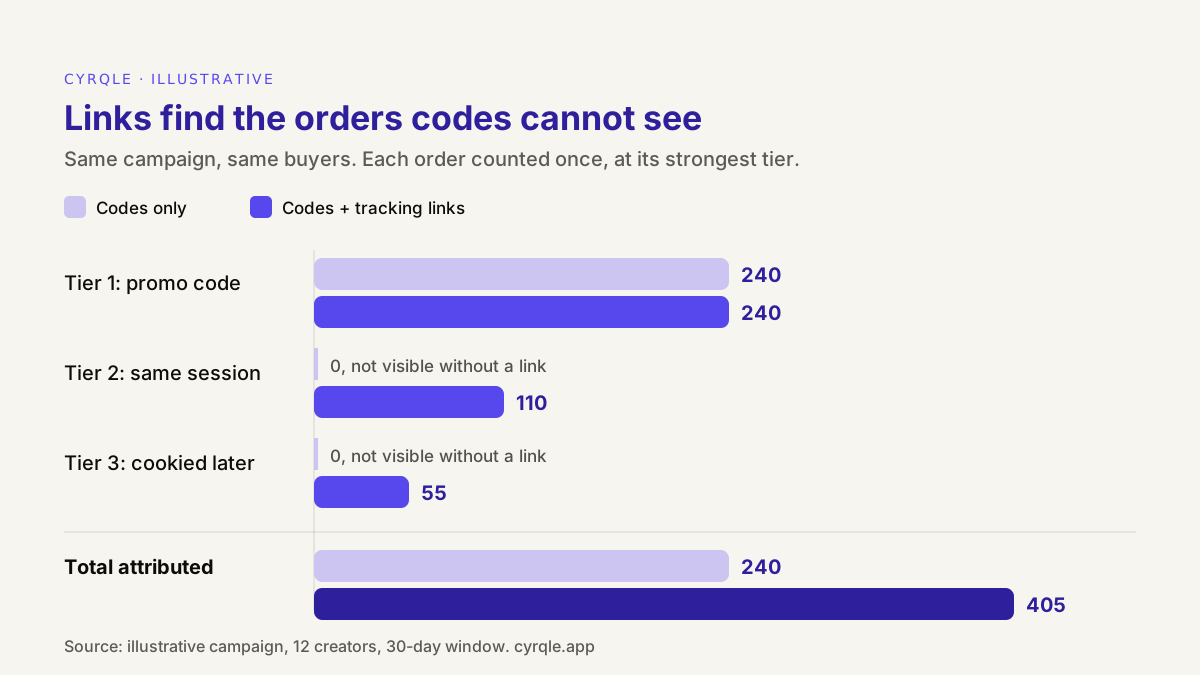
Pair every code with a tracking link because the code sees only the buyers who type it. Many Black Friday buyers tap a creator's link, see the sitewide price, and pay without a code. Others click on Monday and come back on Friday. A code-only report misses both groups, and they are often your best customers, because they paid a higher price.
A tracking link with a small tag on your store records the click. When the buyer orders in the same visit, the sale is Tier 2: same session. When the buyer comes back on the same browser within the window, the sale is Tier 3: cookied later. The code stays the strongest evidence, Tier 1, and each order counts once at its strongest tier.
Worked example
Twelve creators for a Spanish fashion brand on Shopify, Black Friday week, 30-day window. All figures are illustrative.
| Measure | Codes only | Codes plus links |
|---|---|---|
| Tier 1: promo code | 240 orders | 240 orders |
| Tier 2: same session | Not visible | 110 orders |
| Tier 3: cookied later | Not visible | 55 orders |
| Total attributed orders | 240 | 405 |
| Revenue at EUR 52 average order value | EUR 12,480 | EUR 21,060 |
| Of which flagged as possible leakage | 30 orders | 30 orders |
Three points come out of the table. The code-only report understates the campaign by about 40% of orders. The links do not change Tier 1; they add the sales a code cannot see. And the 30 flagged code orders sit inside Tier 1 in both columns, which is why a leakage check comes before any commission is paid.
The tiers tell you how strong the link between a sale and a creator is. They do not tell you whether the sale would have happened without the creator. To answer that, run a simple holdout test. For the full cost and margin calculation behind a number like EUR 21,060, see how to measure influencer marketing ROI beyond the discount code.
Make the link apply the code
On Shopify, a link to /discount/<code> opens the store with the code already applied, as long as that discount exists in Shopify. A buyer who taps it gets the creator's price without typing anything, and the order carries the code, so it lands in Tier 1. For codes with random suffixes, this is the main way buyers will use them. The guide to tracking creator sales on Shopify covers the pixel, webhooks and test orders that make the chain reliable.
A pre-freeze checklist for creator codes
Run this list in week 9 of your plan, before the store freezes changes:
- One code per creator for this campaign. No shared codes, no codes from earlier campaigns.
- Names without discount numbers, generic words or look-alike characters.
- Start date, end date and one use per customer set in the store. Total cap only if someone will watch it.
- Stacking decided, tested on the sale price, and written in the creator brief.
- A tracking link per creator, ideally one that applies the code.
- A real test order for every code, with the order confirmed in your attribution report.
- A contract clause on where the code may be shared.
- A named person who checks redemptions daily during peak week.
How cyrqle helps
In Attribution, every creator gets a promo code and a tracking link automatically when they accept the campaign. Codes follow one pattern: a prefix from the campaign name, six letters from the creator's handle and five random characters, with look-alike characters such as 0, O, 1, I and L left out; the pattern is fixed, so you cannot choose the name. On the campaign Attribution tab, View links & codes lists every code with live click and redemption counts and exports the list as CSV. Mint codes for everyone fills gaps across the roster in bulk, and Mint a link or code adds a code for a late joiner or a second placement.
For Shopify, cyrqle can create the matching discount in your store if you paste an Admin API token with the write_discounts scope and set a percentage. This is opt-in. Each discount ends on the campaign's end date and can be used once per customer. cyrqle does not set a total usage cap or change your combination settings, so check those on each discount in Shopify before the freeze. When cyrqle creates the discount, the creator's brief also shows an auto-apply link that opens your store with the code applied. See the Shopify integration for what is included: there is no App Store app, and setup is a pasted pixel plus order webhooks.
The Attribution tab counts each order once by confidence tier, Tier 1 — promo code, Tier 2 — same-session and Tier 3 — cookied later, with a 30-day window and revenue net of refunds. An audit chain links each sale to the post, code, creator and operator. Commission owed is calculated and shown; paying it is a separate step that a person triggers. cyrqle does not measure incrementality and does not flag leakage automatically, so the redemption checks above stay with your team. To see codes, links and tiers on your own store, book a 30-minute demo.
FAQ
What percentage should a creator code give on Black Friday?
Give enough on top of your sitewide offer that typing the code is worth it, usually a small extra such as a few percent, a gift or free shipping. Matching the sitewide discount exactly gives buyers no reason to use the code. Work out the margin per order for each option before you choose.
Can two creators share one Black Friday code?
No. A shared code cannot tell you which creator drove the sale, so you cannot compare creators or pay commission fairly. Give each creator a unique code for this campaign, even if the discount is identical.
When should creator codes expire?
End them shortly after Cyber Monday, for example on 2 December 2026, unless the creator runs a later post you have agreed in the contract. A code with no end date keeps giving discounts after the campaign, and leaked codes keep circulating.
Should I pay commission on code sales that came from coupon sites?
Review them first. Report them inside Tier 1, mark them, and decide with the creator before the commission run. Write the rule into the contract, so the creator knows in advance that leaked redemptions can be excluded.
Do I still need codes if I use tracking links?
Yes. Codes are the only method that works without a click, survives a rejected cookie banner and works at a till. Links add the buyers who do not type the code. Use both, and count each order once.
Sources
- Shopify Help Center, amount off discounts (usage limits, active dates, time zone): https://help.shopify.com/en/manual/discounts/discount-types/percentage-fixed-amount
- Shopify Help Center, combining discounts (discount classes, combination settings, code limits per order): https://help.shopify.com/en/manual/discounts/discount-combinations
- Ley 7/1996, de 15 de enero, de Ordenación del Comercio Minorista, article 20 (price reductions): https://www.boe.es/buscar/act.php?id=BOE-A-1996-1072
Related field notes.
Buen Fin influencer marketing in six weeks: book Mexican creators, give each a promo code, label every post as advertising and record bank-transfer payouts.
TikTok Shop vs Shopify for creator sales in Spain: in-app conversion against customer data, margin, returns and attribution, with a worked example in euros.
Black Friday influencer marketing for 2026, week by week: shortlist creators in September, sign in October, mint codes before your freeze, peak on 27 November.