
Spain's influencer law: does it affect you as a creator?
Spain's influencer law for creators: the BOE thresholds in RD 444/2024, why most creators sit below them, and the label rules that still apply to everyone.
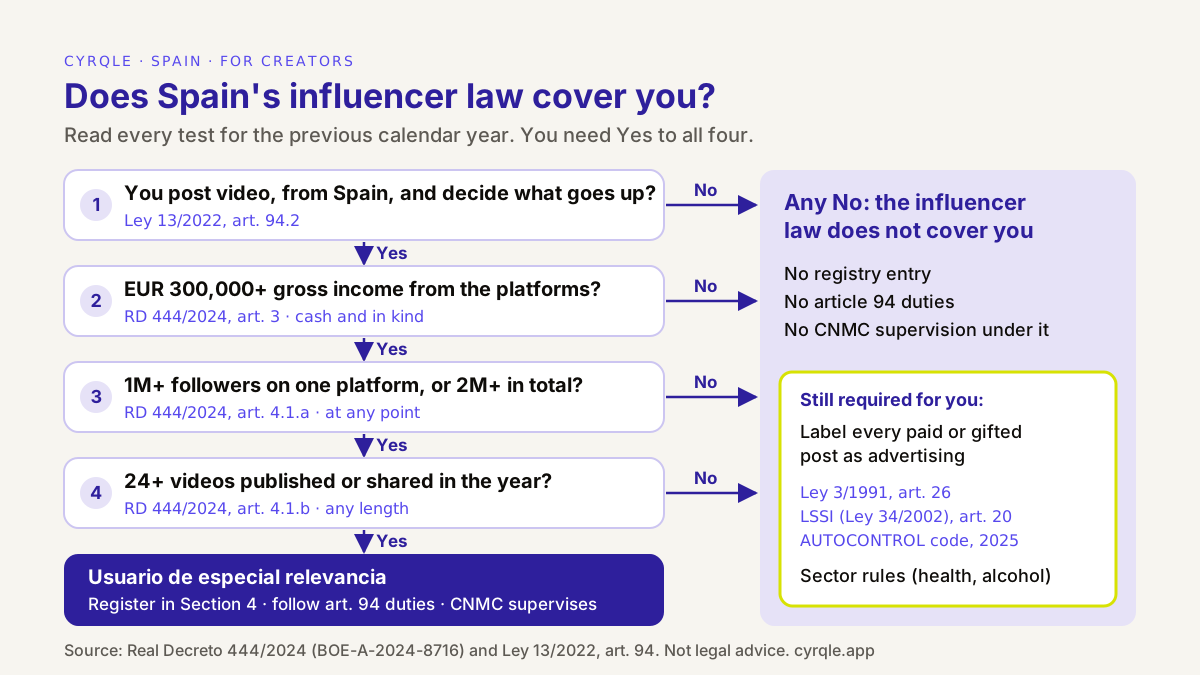
Spain's influencer law affects you as a creator only if you are a "usuario de especial relevancia": in the previous calendar year you earned EUR 300,000 or more in gross income from video platforms, reached 1 million followers on one platform or 2 million in total, and published 24 or more videos. Most creators do not meet all three tests, so they do not register and the CNMC does not supervise them under that law.
That does not mean you have no rules. Whether you have 4,000 followers in Zaragoza or 400,000 on TikTok, every paid or gifted post must be clearly identified as advertising. That duty comes from older laws and from the AUTOCONTROL influencer code, and brands write it into almost every contract they send you.
This post reads the thresholds from the BOE text, explains why few creators cross them, works through three illustrative creators, and lists what applies to everyone. It is written for creators in Spain. If you work with brands and want their side, read our explainer of Real Decreto 444/2024 for advertisers. It is not legal advice: for your specific case, ask a lawyer or an asesor.
Last verified against the consolidated BOE text of RD 444/2024 and the sources listed at the end. Check the BOE for amendments before you rely on it.
What is Spain's "influencer law"?
Spain's "influencer law" is article 94 of Ley 13/2022, General de Comunicación Audiovisual, together with Real Decreto 444/2024, which sets the numbers. Article 94 creates the figure of the "usuario de especial relevancia" (user of special relevance) and treats those creators, for some rules, like small TV channels. The decree was published in the BOE on 1 May 2024 and came into force on 2 May 2024. Without it, article 94 had no numbers and could not apply.
People also call other rules "the influencer law": the AUTOCONTROL code of conduct, the general ban on covert advertising, even tax rules on gifted product. They are separate. The table below sorts them by whether your size matters.
| Rule | Does your size matter? | What it asks of you |
|---|---|---|
| Ley 13/2022, art. 94 + RD 444/2024 | Yes. Only above all thresholds | Register, follow audiovisual advertising rules, CNMC supervision |
| Ley 3/1991 (unfair competition), art. 26 | No | Paid promotion must not look like independent content |
| Ley 34/2002 (LSSI), art. 20 | No | Commercial messages online must be clearly identifiable, and so must the brand behind them |
| AUTOCONTROL influencer code (2025 version) | No | How to label, where to put the label, which words work |
| Sector rules (health, food supplements, alcohol, gambling) | No | Limits on claims and on who can advertise what |
For the full brand-side map of these rules, see our legal checklist for influencer marketing in Spain.
What are the thresholds in Real Decreto 444/2024?
A creator is a usuario de especial relevancia only when all five conditions of article 94.2 of Ley 13/2022 are true at the same time. Three are qualitative. Two have numbers, set by articles 3 and 4 of the decree. Every number is measured over the previous calendar year.
| Test | Source | The number or condition |
|---|---|---|
| Significant income | RD 444/2024, art. 3 | EUR 300,000 or more in gross income, accrued in the previous calendar year, only from your activity on video-sharing platforms |
| Significant audience | RD 444/2024, art. 4.1.a | 1,000,000 followers on a single platform, or 2,000,000 across all platforms, "at some point" in the previous calendar year |
| Volume | RD 444/2024, art. 4.1.b | 24 or more videos published or shared in the previous calendar year, of any length |
| Editorial control and purpose | Ley 13/2022, art. 94.2.b and d | You decide what goes on the channel, and its purpose is to inform, entertain or educate |
| Established in Spain | Ley 13/2022, art. 94.2.e | A creator established in another country falls under that country's rules |
What counts as income toward the EUR 300,000?
Article 3.2 of the decree lists five kinds of income, all from your activity on the platforms:
- Payment for commercial content, "tanto de remuneraciones dinerarias como en especie": cash fees and also product, trips and services you get in exchange for content.
- Money paid to you by the platforms, such as creator funds and revenue shares.
- Subscriptions and payments from your audience.
- Public grants linked to the activity.
- Any other income from the activity on the platforms.
The test counts gross income, not profit. Your agency's commission and your expenses do not reduce it. If you are close to the line, count the market value of gifted product and trips, not just invoices.
How are followers and videos counted?
The audience test is met if you hit 1 million followers on one platform at any moment of the year, or 2 million added across every platform you use. A spike in December counts for the whole year. The volume test is 24 videos across all platforms, whatever their length, so a Reel, a Short and a TikTok each count. The decree does not explain how followers are verified or whether Stories count as videos. Treat those as open questions.
Why are most creators below the line?
Most creators are below the line because the tests are cumulative and set high. You need the income, the audience and the volume at the same time. A creator with 1.5 million TikTok followers who earns EUR 120,000 is out. A creator who earns EUR 400,000 from brand deals with 600,000 followers is also out.
The official count shows how small the group is. A report by the Consejo Audiovisual de Andalucía, signed on 28 November 2025, says the state registry held 104 registered usuarios de especial relevancia at the time it was written, 13 of them from Andalusia. Registration and qualifying are not the same thing, since some creators who qualify may not have registered, but the order of magnitude is clear: around a hundred people, not thousands.
The income test is usually the hardest. EUR 300,000 gross a year is a large income for a creator, and most audiences big enough to reach it are already in the million-follower range. That is also why gifts matter: a creator with modest cash income but heavy product and travel deals can get closer than they think.
Worked example: three creators, one year
The three creators below are illustrative. The figures are invented to show how the tests combine; they are not benchmarks.
| Laura, lifestyle, Valencia | Dani, fitness, Madrid | Inés, travel, Barcelona | |
|---|---|---|---|
| Followers (peak in 2025) | Instagram 95,000, TikTok 140,000 | TikTok 1,200,000 | Instagram 900,000, TikTok 1,250,000 |
| Videos in 2025 | 180 | 220 | 70 |
| Cash from brands and platforms | EUR 41,000 | EUR 140,000 | EUR 215,000 |
| Product, trips and services (market value) | EUR 6,000 | EUR 15,000 | EUR 98,000 |
| Gross income test (EUR 300,000) | No: EUR 47,000 | No: EUR 155,000 | Yes: EUR 313,000 |
| Audience test (1M on one, or 2M total) | No | Yes: 1.2M on TikTok | Yes: 1.25M on TikTok (2.15M in total) |
| Video test (24+) | Yes | Yes | Yes |
| Usuario de especial relevancia in 2026? | No | No | Yes, if established in Spain with editorial control |
Inés is the interesting case. Her cash income alone, EUR 215,000, would leave her out. The hotel nights, flights and product she received in exchange for content push her over EUR 300,000. Her 1.25 million TikTok followers clear the audience test on their own. Laura and Dani are outside article 94, but every sponsored Reel they publish still needs a label.
Status is measured year by year. If Dani has a strong 2026, he can qualify in 2027. Recheck your numbers each January with the previous year's totals.
What changes if you are above the thresholds?
If you pass every test, you become a usuario de especial relevancia and article 94.1 of Ley 13/2022 applies a set of audiovisual rules to you:
- Register. You apply to Section 4 of the Registro Estatal de Prestadores del Servicio de Comunicación Audiovisual, the state registry set up by Ley 13/2022 and organised by Real Decreto 1138/2023. The registry can be consulted online.
- Advertising rules. Sponsored content must be clearly distinguishable from editorial content, covert advertising is banned, and there are limits on content harmful to minors and on health-related advertising.
- The platform tool. You must use the platform's feature for declaring commercial content.
- A regulator. The CNMC supervises registered providers and can require changes or open sanction proceedings.
The CNMC also reads the label rules more strictly than the code. In a press release of 3 June 2026 about requirements sent to five creators, it said that "ad", "embajadora", "#publi" in the caption only and the platform tools were not enough on their own: "publicidad" or "publi" must appear visibly inside the video itself, under its interpretative criterion of June 2025. In the same release it said a post can be commercial even without payment or a contract. If you are near the thresholds, adopt that standard now.
What applies to every creator, whatever your size?
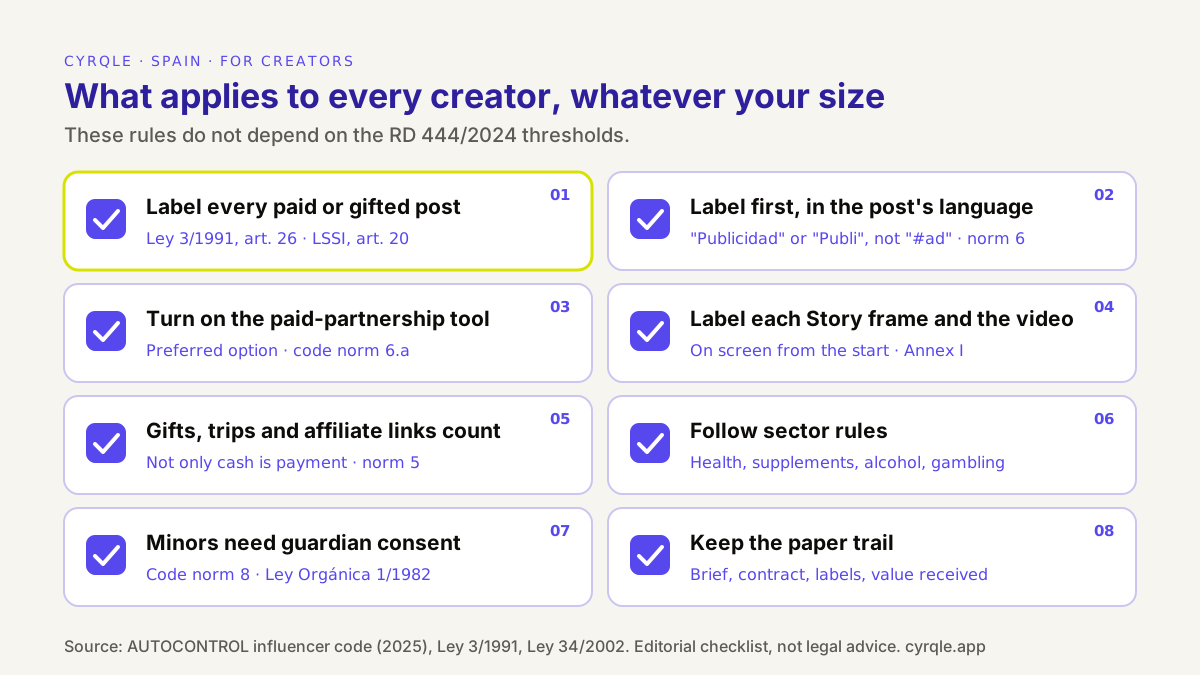
Every creator in Spain who publishes paid or gifted content must make it clearly identifiable as advertising. This duty has nothing to do with RD 444/2024. It comes from three sources:
- Ley 3/1991, article 26, treats as misleading a promotion that a business pays for and presents as ordinary content without making clear it is advertising.
- The LSSI (Ley 34/2002), article 20.1, requires electronic commercial communications to be "claramente identificables" as such, and the person or company behind them to be identifiable too. In practice: label the post and name or tag the brand.
- The AUTOCONTROL influencer code, second version in force since 1 October 2025, owned by the aea, AUTOCONTROL and IAB Spain. It sets out which labels work and where they go.
You may think the code does not bind you because you never signed it. In practice it reaches you anyway. Norm 3 asks adherent companies to put compliance with the code into their creator contracts, so most briefs from large brands include it. Norm 12 says liability can reach everyone involved in the communication, and a brand can escape only by proving the breach came from a clear failure to follow its instructions. If the brief told you to label and you did not, the problem lands on you. Our guide to the AUTOCONTROL influencer code covers every norm in detail.
Which labels work, and which do not?
Norm 6 of the code sorts labels into three groups. The platform's own paid-partnership tool is the preferred option. Clear words in the language of the post are accepted. Vague words, a foreign-language label and a brand hashtag on its own are not enough.
| Status under the code | Safe for large creators (CNMC)? | |
|---|---|---|
| Platform tool ("Colaboración pagada con [marca]") | Preferred | Not enough alone; add "Publi" on screen |
| "Publicidad" or "Publi" at the start | Accepted | Yes, if also visible in the video |
| "En colaboración con", "Patrocinado por", "Embajador de [marca]" | Accepted | Not reliable; the CNMC rejected "embajadora" |
| "#ad" or "Advertising" in a Spanish post | Not enough (wrong language) | No |
| "Gracias a [marca]", "Regalo de [marca]", "Colab", "sp" | Not enough | No |
| The brand's hashtag on its own | Not enough | No |
The label also has to be in the right place. Norm 6.d says at the start of the message, easy to see, not mixed into a run of hashtags and not hidden behind "more". Annex I adds format rules: on Stories, label every frame, not just the first; on video, show it from the start of the promotional part. For a definition you can send to a brand or a manager, use our glossary entry on disclosure in creator marketing.
Does gifted product count as an ad?
Yes. Norm 5 of the code lists what counts as payment: direct or indirect payment, free product, free entry to events, free services, affiliate links, gift cards, gift bags and trips. If a brand sent you a product and you post about it, label it, even if nobody paid you cash. Our guide to deciding between a gifted collaboration and a paid one covers when a gift is worth your time.
The exception is genuinely independent content. If you bought the product yourself, there is no deal with the brand, and nobody asked you to post, the code does not treat it as advertising. Do not lean on that too far: the CNMC has said a post can count as commercial communication without payment if it promotes the brand. Keep that boundary honest: the Jurado de la Publicidad can infer a deal from signs such as a discount code, a past collaboration or the same message posted by other creators at the same time.
Who can act against you if you are below the thresholds?
Below the thresholds the CNMC has no article 94 powers over you. Your exposure comes from three other directions. First, the brand: a contract that requires labels can let the brand withhold payment or end the deal if you skip them. Second, the Jurado de la Publicidad, which hears complaints under the code from competitors, consumer groups and consumers. Third, the general law on unfair and misleading commercial practices, applied by courts and consumer authorities. None of these depends on your follower count.
A five-step routine before every sponsored post
- Classify the deal. Cash, product, trip, affiliate link or event entry: any of these makes the post advertising.
- Write the label first. "Publicidad" or "Publi" as the first word of the caption, in Spanish for a Spanish post, and tag the brand.
- Turn on the platform tool and put "Publi" on screen from the start of a video and on every Story frame.
- Check the sector. Health, food supplements, alcohol and gambling have their own rules; do not make health claims the brand has not approved.
- Keep the record. Save the brief, the signed contract, the approved draft and a note of what you received, in cash and in kind. It proves you labelled, and it gives you the numbers for the January threshold check and for your invoice to the brand.
How cyrqle helps
cyrqle cannot tell you whether you are a usuario de especial relevancia. That depends on your income, which no platform sees, and on the registry. What the creator side of cyrqle does is keep each brand deal and its terms in one place, so the routine above leaves a record.
- Briefs with the rules written in. In the briefs inbox on cyrqle for creators, each brief states the deliverables and the required hashtags and handles the brand set in Campaigns. When the brand turns on draft sign-off, it reviews your draft and cyrqle checks the caption for those hashtags and handles. The check confirms the text is there; it does not judge where the label sits, so put "Publi" first yourself.
- A signed contract you can find later. You sign the Creator Collaboration Agreement with two-sided e-signature, and cyrqle stores a snapshot of the terms, including whether the deal is cash, commission, product or a mix, set out in compensation and contracts.
- A payouts ledger. Your payouts appear in one ledger, which helps when you add up the year's income in January. Payouts go through Stripe Connect for creators in Europe and the US.
The creator app is open by waitlist. For the commercial side of a deal, from pricing to payment, read our creator's guide to brand deals.
FAQ
Do I have to register as an influencer in Spain?
Only if you meet every test for the previous calendar year: EUR 300,000 or more in gross income from video platforms, 1 million followers on one platform or 2 million in total, 24 or more videos, editorial control and establishment in Spain. If you miss any one, you do not register.
I have 1.2 million followers. Am I covered?
Not on followers alone. You also need EUR 300,000 in gross income from your platform activity and 24 or more videos in the same year. A creator with a large audience and a lower income is outside article 94, though the labelling duty still applies.
Do gifted products count toward the EUR 300,000?
Yes. Article 3.2.a of RD 444/2024 counts payment "en especie" for commercial content, so product, trips and services received in exchange for content add to the total. Keep a note of their market value.
Is "#ad" enough on a Spanish post?
No. The AUTOCONTROL code rejects "Ad" and "Advertising" in a post written in another language, and it rejects labels buried among other hashtags. Use "Publicidad" or "Publi" at the start, plus the platform's paid-partnership tool.
Does the law apply if I live outside Spain but have a Spanish audience?
Article 94 applies to creators established in Spain. A creator established in another EU country falls under that country's rules. If you work with Spanish brands, their contracts will usually still require Spanish labelling standards. Our overview of disclosure rules by country covers other markets.
What happens if I forget to label a sponsored post?
Fix it as soon as you notice: edit the caption, add the platform tool and repost Stories if needed. Depending on the contract, the brand may withhold payment. A complaint can also go to the Jurado de la Publicidad, and for registered large creators the CNMC can issue requirements or sanctions.
Sources
- Real Decreto 444/2024, de 30 de abril (BOE-A-2024-8716), arts. 3 and 4 and single additional provision: https://www.boe.es/buscar/act.php?id=BOE-A-2024-8716
- Ley 13/2022, de 7 de julio, General de Comunicación Audiovisual, art. 94: https://www.boe.es/buscar/act.php?id=BOE-A-2022-11311
- Real Decreto 1138/2023 on the state audiovisual registry: https://www.boe.es/buscar/act.php?id=BOE-A-2023-25886
- Ley 3/1991, de Competencia Desleal, art. 26: https://www.boe.es/buscar/act.php?id=BOE-A-1991-628
- Ley 34/2002 (LSSI), art. 20: https://www.boe.es/buscar/act.php?id=BOE-A-2002-13758
- Consejo Audiovisual de Andalucía, Informe sobre la influencia digital en Andalucía 2025 (signed 28 November 2025): https://consejoaudiovisualdeandalucia.es/wp-content/uploads/2025/11/INFORME-INFLUENCIA-DIGITAL-EN-ANDALUCIA.pdf
- CNMC press release on requirements to five influencers, 3 June 2026: https://cnmc.es/prensa/requerimientos-influencer-20260603
- AUTOCONTROL, Código de Conducta sobre el uso de influencers en la publicidad (2025): https://www.autocontrol.es
Related field notes.
Influencer regulation in Latin America: what PROFECO, SIC, CONARP and SERNAC expect, the label each market wants and one caption that fits all four.
What the AUTOCONTROL influencer code of conduct (October 2025) asks of brands: accepted labels, placement by format, the #ad question and a brand checklist.
Spain's influencer law, Real Decreto 444/2024, explained for brands: who is a usuario de especial relevancia, the BOE thresholds, the registry and your duties.