
Who is liable for a creator's post in Spain: the brand or the creator?
Brand liability for influencer posts in Spain: how hidden ads and misleading claims are shared with the creator, and what to put in the brief and contract.
In Spain, liability for a sponsored creator post is usually shared. The creator who publishes and the brand that pays can both answer for hidden advertising or a misleading claim, and an agency in the middle can too. The question that decides your exposure as a brand is rarely "who posted it?" but "what did you instruct, approve and correct, and can you prove it?"
Picture a supplements brand in Valencia paying six creators for a launch. One drops the "Publicidad" label and adds "it cured my anxiety" after approval. A competitor files a complaint. The creator wrote the words, but your product, your money and your campaign are in the post. This article explains how Spanish law splits responsibility by type of risk, what to write in the brief and the contract to reduce it, and how to keep the record that proves you did your part. It is not legal advice: for a specific campaign, ask your lawyer.
Who is legally responsible for a sponsored creator post in Spain?
Both the advertiser and the creator can be responsible, because Spanish law attaches liability to the conduct, not only to the account that published it. The anunciante (advertiser) is "the natural or legal person in whose interest the advertising is made" under article 8 of the Ley General de Publicidad. In a paid collaboration, that is you.
Four sets of rules decide who answers for what. Our legal checklist for influencer marketing in Spain maps all of them; here is the liability view.
| Rule | What it prohibits | Who it can reach |
|---|---|---|
| Ley 3/1991, de Competencia Desleal, arts. 5, 7 and 26 | False or misleading information, omitting material information, and paid promotion on social networks not clearly marked as advertising | Anyone who carried out, ordered or cooperated in the conduct (art. 34.1) |
| Consumer law (TRLGDCU), arts. 19, 47 and 49 | Unfair commercial practices towards consumers, as an administrative infringement | The business that uses the practice |
| LSSI (Ley 34/2002), art. 20 | Electronic commercial communications that are not clearly identifiable, or that hide who they are made for | Information society service providers (art. 37) |
| AUTOCONTROL influencer code (2025), norm 12 | Any breach of the code, including labels and misleading content | "All parties involved in the commercial communication", with one defence |
Large creators carry one more layer. Those who meet the thresholds of Real Decreto 444/2024 on users of special relevance follow audiovisual advertising rules and answer to the CNMC. That duty is theirs, not yours, but the same facts can support a complaint against the brand under Ley 3/1991.
How does liability split by type of risk?
Liability lands differently depending on what went wrong. A missing label is a shared problem. A false claim you wrote into the brief is mostly yours. A song the creator used without a licence is mostly theirs, until you repost the video.
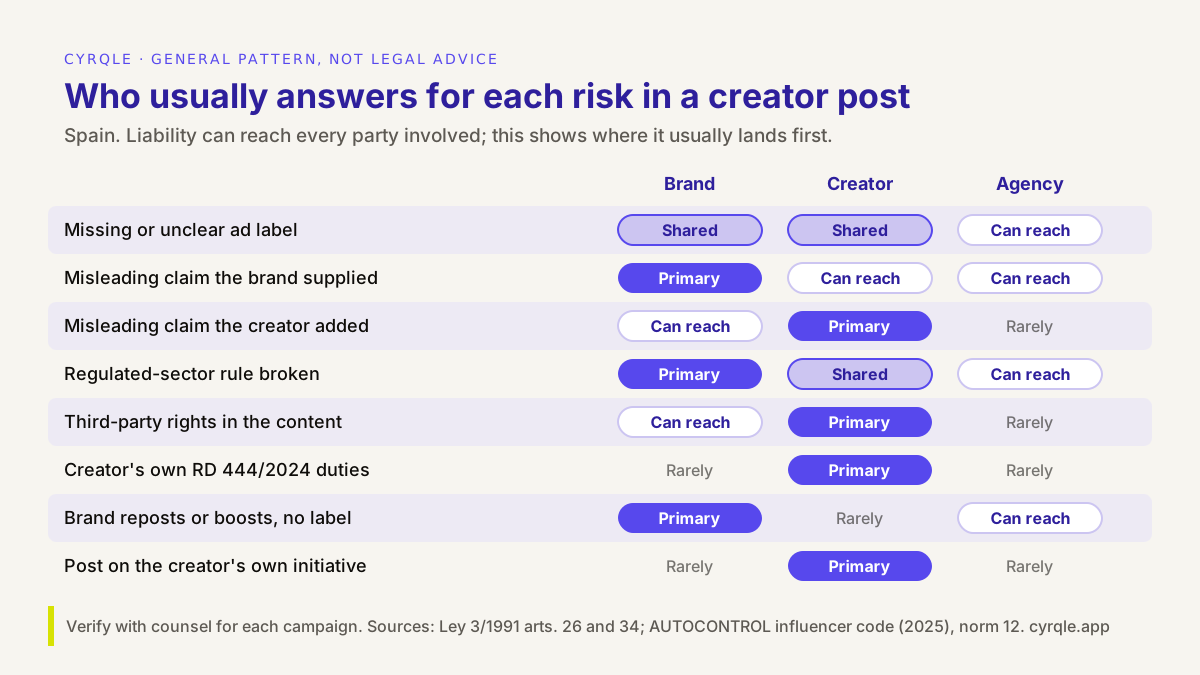
Read the matrix as "where it usually lands first", not "who is safe". Under article 34.1 of Ley 3/1991 and norm 12 of the code, every party involved can be reached. The table below gives the reasoning behind each row.
| Risk | Usually lands first on | Why |
|---|---|---|
| Missing or unclear "Publicidad" label | Brand and creator, shared | Art. 26 describes promotion the business pays for; the creator publishes it |
| Misleading claim the brand supplied | Brand | You ordered the message (art. 34.1: "ordered") |
| Misleading claim the creator added | Creator, brand can be reached | You paid and, if you approved the draft, you saw it |
| Sector rule broken (food, cosmetics, alcohol, gambling, finance) | Brand, creator can share | Sector rules bind the advertiser of the regulated product; norm 2 of the code points to them |
| Third-party rights (music, trademarks, people in frame) | Creator | The creator made the content; you inherit the risk when you reuse it |
| Creator's own RD 444/2024 duties (register, audiovisual rules) | Creator | The decree puts the duty on the creator |
| Brand reposts or boosts without the label | Brand | Norm 6.e: the label must stay or be added when content is shared |
| Post made on the creator's own initiative | Creator | Norm 12: with no link to the advertiser, liability can sit with the creator alone |
Why can't the brand blame the creator for hidden advertising?
The brand cannot simply point at the creator, because the law on covert advertising is written around the business that pays. Article 26 of Ley 3/1991 treats as misleading any promotion on social networks "paid for by the business" that is not clearly identified as advertising. Without your payment or gift, there is no advertising to hide.
Two further rules close the gap.
- Article 34 of Ley 3/1991. Actions can be brought "against any person who carried out or ordered the unfair conduct or cooperated in it". Paragraph 2 adds that when the conduct is carried out by "workers or other collaborators" in the exercise of their contractual duties, the declaratory, cessation, removal and rectification actions must be brought against the principal. Whether a paid creator counts as a "collaborator" in that sense is a point for your lawyer, but the text points at the brand.
- Norm 12 of the AUTOCONTROL code. Liability "can reach all parties involved in the commercial communication". A party escapes only if it proves "sufficiently" that the breach came from a one-off, clear failure to follow the instructions given to the influencer.
Norm 4 of the code adds a twist. Among the signs that a post is advertising, it lists "the existence of editorial control over the content". Approving drafts is editorial control. It makes the commercial link easier to prove, so it only helps you if your instructions were right and the label was in them.
That is why this article keeps returning to evidence. The defence in norm 12 is a paper defence. If you cannot show the instruction, you cannot show the creator broke it.
Who answers for a misleading claim in a creator's post?
The party that made the claim up answers first, but the brand rarely gets out entirely. Article 5 of Ley 3/1991 treats as misleading any information that is false, or true but presented in a way that can mislead, when it can change a consumer's economic decision. Article 7 adds the omission of material information.
Split claims into three groups when you write the brief:
- Claims you supply. Product facts, prices, discounts, results. If they are wrong, they are yours. Give the creator the exact wording and the substantiation behind it.
- Claims the creator adds. Personal experience ("my skin feels softer") is normal. Results the product cannot prove ("I lost 6 kg in two weeks") are not. List the claims the creator must not make.
- Regulated claims. Food and supplements may only use authorised health claims under Regulation (EC) 1924/2006, and article 7.3 of Regulation (EU) 1169/2011 bars attributing to a food the property of preventing, treating or curing a human disease. Cosmetic claims must meet the common criteria in Regulation (EU) 655/2013: truthful, supported by evidence, honest and fair. Alcohol, gambling and financial products have their own advertising rules. A creator saying it in their own words does not change the rule.
Norm 10 of the code covers the reverse case: a creator who claims or implies a sponsorship that does not exist is acting misleadingly. That one is the creator's.
What can actually happen, and who starts it?
Five routes exist, and they reach different parties. The fines below are the ranges written in the law, not typical outcomes.
| Who starts it | Who it can target | What can follow | |
|---|---|---|---|
| Unfair competition action (Ley 3/1991, arts. 32-34) | A market participant whose economic interests are directly harmed or threatened, such as a competitor (art. 33.1) | Anyone who carried out, ordered or cooperated; the principal for collaborators (art. 34) | Declaration, cessation, removal, rectification, and damages where there was intent or fault (art. 32.1) |
| Consumer authority (TRLGDCU, arts. 47 and 49) | National or regional consumer authorities | The business using the unfair practice | Fines from EUR 150 to EUR 1,000,000 by severity, which can rise to a multiple of the illicit profit |
| LSSI, art. 20 | The competent administration | Information society service providers (art. 37) | Minor infringement (art. 38.4.c), fine up to EUR 30,000 (art. 39.1.c) |
| AUTOCONTROL Jurado de la Publicidad | Competitors, associations, public bodies or consumers | Parties bound by the code | A ruling that the content breaches the code and should be corrected or withdrawn |
| CNMC (Ley 13/2022) | The CNMC | Users of special relevance | Sanctions on the creator under the audiovisual law |
Quoted from the BOE consolidated texts. In practice, the cost that hits brands most often is not a fine. It is a public ruling with your brand name in it, a takedown in the middle of a launch, and a creator relationship that ends badly. The controls below reduce all three.
What should the brief say to reduce brand liability?
The brief is your instruction, and under norm 12 the instruction is your defence. Write it so a stranger could read it in a year and see exactly what you asked for. Our creator brief template has the fields; for liability, these are the lines that matter.
- The label rule, word for word. "Start the caption with 'Publicidad'. Turn on the platform's paid-partnership label. On Stories, 'Publi' on every frame." The AUTOCONTROL code explainer lists which labels pass.
- Approved claims. The exact product claims the creator may make, with the source for each.
- Banned claims. Health, cure, guaranteed-results and before-and-after claims you do not want, written as examples.
- Required elements. Brand handle, hashtags, discount code, link.
- Rights in the content. No unlicensed music, no third-party logos, no people in frame without their consent, no minors without written parental consent.
- What happens if something goes wrong. "If we ask for a correction, fix it within 24 hours and confirm in writing."
What should the contract say?
The contract turns the brief into a duty. Norm 3 of the code asks that agreements with influencers include the duty to comply with the code. Our influencer contract template for Spain sets out each clause; these are the ones that move liability.
| Clause | What it does | Limit to know |
|---|---|---|
| Duty to comply | Creator agrees to follow the law, the AUTOCONTROL code and the brief | Binds the creator to you, not a regulator to the creator |
| Approval right | Nothing goes live without written approval; changes after approval need re-approval | Only helps if you actually review |
| Correction and takedown | Creator fixes or removes content within a set time on request | Set the time in hours, not "promptly" |
| Rights warranty | Creator warrants the content does not infringe third-party rights | Worth only as much as the creator can pay |
| Indemnity | Creator covers your costs if their breach causes a claim | Shifts money between you; it does not stop an action against the brand |
| Paid-use scope | Whether you can boost or reuse the content, where and for how long | Keep the label on any reuse (norm 6.e) |
| Declaration on RD 444/2024 | Creator states whether they are a user of special relevance and registered | Cheap, and tells you which rules apply |
If you plan to run creator content as ads, the extra terms are covered in the contract terms for whitelisting and partnership ads.
How do you evidence approvals so they stand up later?
You evidence approvals by keeping, for each post, a dated chain from instruction to live content. Draft approval is the middle link: it shows you checked before publication and that the label and claims were right at that point.
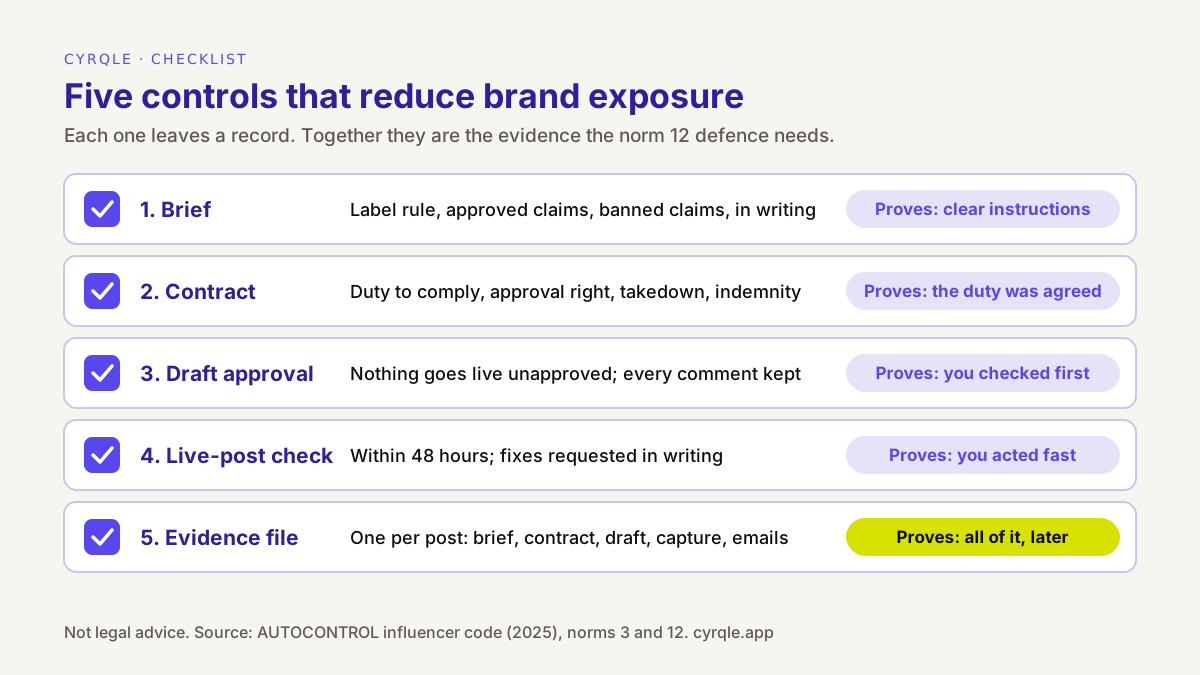
The five controls work as a chain:
- Brief. Versioned and dated, with the label rule and claim lists.
- Contract. Signed by both sides, with the date and the terms frozen at signature.
- Draft approval. The draft itself, who reviewed it, every comment, and the final approval. Avoid approving by voice note or a thumbs-up emoji in a chat you cannot export.
- Live-post check. Within 48 hours, compare the live post with the approved draft. If anything changed, ask for the fix in writing the same day.
- Evidence file. One per post: brief, contract, approved draft, capture of the live post, correction requests and replies, payment record.
Our compliance audit guide covers what to log per post and for how long.
Worked example: one launch, two incidents
The figures are illustrative. A food-supplement brand runs a six-creator Instagram launch in Spain, EUR 1,500 per creator, EUR 9,000 in fees. The brief lists two approved claims taken from authorised health claims and bans "cures", "treats" and weight-loss figures. Every creator signs a contract with the duty to comply and a 24-hour correction clause. Drafts are approved in writing.
On day 2, the live-post check finds two problems.
| Creator C | Creator E | |
|---|---|---|
| What went wrong | Approved caption had "Publicidad"; live caption moved it after 20 hashtags | Added "me quitó la ansiedad" after approval |
| Instruction on record | Brief label rule, contract clause, approved draft | Banned-claims list, contract clause, approved draft without the claim |
| Brand response | Written correction request at 10:40, fixed at 13:15 | Written takedown request at 10:45, caption edited at 12:30 |
| Defence position | Best position the brand can have: a one-off breach of a clear instruction, all on file | Same, for the claim; the brand still removes the post and keeps the record |
Run the same launch with briefs sent by voice note and approvals given in a chat. The facts are identical, but the brand can no longer show what it instructed. The norm 12 defence then rests on memory, and a disease claim on a supplement post is the kind a regulator or competitor takes seriously.
How cyrqle helps
cyrqle does not decide whether a post is legal, and it does not replace your lawyer. It keeps the instruction, approval and contract record in one place for each creator, so the evidence file builds as the campaign runs. In Campaigns, the brief, offer, contract, drafts and live posts for each creator sit together.
- Required hashtags and handles. You set them in the brief. With draft sign-off turned on, cyrqle checks each draft for the required hashtags and handles and flags what is missing before you approve. The check confirms the text is present. It does not judge label position or claims, so a reviewer still reads every draft. Published posts on Instagram and TikTok are tracked in the campaign, but the comparison of the live post against the approved draft (control 4) is a step your team does.
- Approve or request changes. Draft sign-off records approval or a change request per draft, so the middle link of the chain is on file.
- Frozen contract terms. Each creator signs the Creator Collaboration Agreement by two-sided e-signature. cyrqle stores a frozen snapshot of the terms with the IP address, device and timestamp of each signature, and you can link your own brand terms, which is where the duty-to-comply clause belongs. Paid-ads use applies only when you tick it on the offer.
- Deal and payment record. Fee, commission and product are set per creator in Compensation and contracts, so the consideration that makes a post advertising is written down.
To see it on your own category, read about cyrqle for brands or book a 30-minute walkthrough.
FAQ
Is the brand liable if the creator forgets the "Publicidad" label?
It can be. Article 26 of Ley 3/1991 describes promotion the business pays for, and norm 12 of the AUTOCONTROL code lets liability reach everyone involved. Your defence is proof that the creator broke a clear instruction in a one-off way: the brief, the contract and the approved draft with the label in it.
Can a contract clause move all the liability to the creator?
No. A clause binds the two of you. It can make the creator pay your costs through an indemnity, but it does not stop a competitor, a consumer authority or the Jurado from acting against the brand. Use it alongside the controls, not instead of them.
Does approving drafts increase the brand's liability?
It makes the commercial link easier to prove, because norm 4 of the code treats editorial control as a sign of advertising. It also gives you the evidence for the norm 12 defence. On balance, approve drafts, and make sure your approval checks the label and the claims.
Who is liable for a gifted post with no contract?
Both can be. Norm 5 of the code counts free product as consideration, so a gifted post that promotes the product is advertising. Without a brief or contract, you have no written instruction to rely on, which weakens your defence. Send gifting with a short written agreement.
Is the agency liable too?
It can be. Norm 1 of the code names influencer and advertising agencies among the parties it binds, and article 34.1 of Ley 3/1991 reaches anyone who cooperated in the conduct. Agencies often write the brief, so unclear instructions can weaken the defence for the agency and the client alike.
Sources
- Ley 3/1991, de 10 de enero, de Competencia Desleal, arts. 5, 7, 26 and 32-34: https://www.boe.es/buscar/act.php?id=BOE-A-1991-628
- Ley 34/1988, de 11 de noviembre, General de Publicidad, art. 8: https://www.boe.es/buscar/act.php?id=BOE-A-1988-26156
- Real Decreto Legislativo 1/2007 (TRLGDCU), arts. 19, 47 and 49: https://www.boe.es/buscar/act.php?id=BOE-A-2007-20555
- Ley 34/2002 (LSSI), arts. 20, 37, 38 and 39: https://www.boe.es/buscar/act.php?id=BOE-A-2002-13758
- AUTOCONTROL, aea and IAB Spain, Código de Conducta de Publicidad a través de Influencers (2025), norms 1-6, 10 and 12: https://www.autocontrol.es/app/uploads/codigo-de-conducta-de-publicidad-a-traves-de-influencers-2025.pdf
- Regulation (EC) No 1924/2006 on nutrition and health claims made on foods: https://eur-lex.europa.eu/eli/reg/2006/1924/oj
- Regulation (EU) No 1169/2011 on the provision of food information to consumers, art. 7.3: https://eur-lex.europa.eu/eli/reg/2011/1169/oj
- Commission Regulation (EU) No 655/2013, common criteria for cosmetic claims: https://eur-lex.europa.eu/eli/reg/2013/655/oj
Related field notes.
Influencer regulation in Latin America: what PROFECO, SIC, CONARP and SERNAC expect, the label each market wants and one caption that fits all four.
Spain's influencer law for creators: the BOE thresholds in RD 444/2024, why most creators sit below them, and the label rules that still apply to everyone.
What the AUTOCONTROL influencer code of conduct (October 2025) asks of brands: accepted labels, placement by format, the #ad question and a brand checklist.