
Sports nutrition and fitness brands: what creators may claim, and how to brief it
Influencer marketing supplements rules in the EU and Spain: the protein, creatine and vitamin claims creators may make, the ones they may not, and how to brief.
A sports nutrition creator in the EU may say only what the EU register of health claims allows, in the register's wording or the same meaning, and only when the product meets the claim's conditions. Everything else that suggests a health effect, from "recover faster" to a before/after photo, is an unauthorised claim. In Spain, the brand also has to keep health professionals, slimming and disease claims out of the post.
Here is how it goes wrong in practice. A creatine brand in Valencia briefs a CrossFit coach in Bilbao and a running creator in Medellín. The coach's first draft says: "I recover twice as fast since I started taking it, and my physio swears by it." That one line has three problems. "Recover" is not an authorised creatine claim. "Twice as fast" promises an effect the register does not support. "My physio swears by it" brings in a health professional, which EU and Spanish rules both ban.
Below: a table of 10 claims sorted into allowed, allowed with conditions and not allowed; the Spanish rules on top of the EU list; creator and imagery rules; a brief checklist and clause library; and a review flow with a human claims check. It is one spoke of our rules matrix for regulated products in Spain and LatAm, which covers alcohol, finance, gambling and products for children as well.
What is the basic rule for supplement claims in creator content?
The basic rule is in Regulation (EC) 1924/2006 on nutrition and health claims. Article 10(1) prohibits health claims unless they are authorised and included in the lists of authorised claims. The main list is in Regulation (EU) 432/2012, amended many times since. The regulation applies to claims made in commercial communications, "whether in the labelling, presentation or advertising of foods" (Article 1(2)). A paid creator post is a commercial communication, so the rule applies to it the same way it applies to the label.
Four more articles matter for a brief:
- Article 2(2)(1): images count. A claim is any message "or representation", including "pictorial, graphic or symbolic representation", that states, suggests or implies a food has particular characteristics. A shaker next to a six-pack in a transformation video can be a claim.
- Article 10(2): mandatory information. When a health claim is made, the communication must also give the importance of a varied, balanced diet and a healthy lifestyle, the quantity and pattern of consumption needed for the effect, and, where relevant, who should avoid the product.
- Article 10(3): vague wellness claims. "Feel your best" or "good for your body" is allowed only when a specific authorised claim goes with it.
- Article 12: three banned types. Claims that suggest health could suffer if you do not take the food; claims about the rate or amount of weight loss; and claims that refer to recommendations of individual doctors or other health professionals.
What counts as a claim in a creator post?
Treat everything the audience sees or hears as part of the claim. That includes the caption, the voice-over, the on-screen text, the hashtags (#fatburner, #recovery, #immunityboost), the setting (a lab coat, a clinic, a pharmacy counter) and the before/after frame. The European supplement trade body EHPM said the same in its influencer guidelines, launched in June 2026: brief influencers on the boundaries, not only the message, and review content before it goes out (NutraIngredients report). The guidelines are self-regulation, not law, but they show what the industry itself expects.
Where do you check a claim?
Use the EU Register of nutrition and health claims. Search the substance (creatine, protein, magnesium), open the authorised entry, and copy two things into the brief: the claim wording and the conditions of use. The register also lists rejected claims, which is useful when a creator asks "why can't I say it helps recovery?". In Spain, the food safety agency AESAN keeps a list of the regulations that amend the authorised list.
The problem is common. In June 2021, Spain's Ministry of Consumer Affairs named caffeine "energy" and creatine "recovery" claims among the unauthorised examples it found on sports supplement labels (La Moncloa press note). A doctoral thesis at the Universidad de Murcia found unauthorised claims on 43.8% of the 46 protein supplements studied, and "post-workout recovery" was the most common one (thesis record). Those are labels, written by brands with legal teams. A creator's caption, written in five minutes, is at higher risk.
Which claims can a fitness creator make? The table
The figure and the table below sort 10 things a creator typically wants to say into three groups. "Allowed" means an authorised claim exists and the condition is simple. "Allowed with conditions" means the claim exists but the post must carry a dose, a population or a product formula. "Not allowed" means there is no authorised claim, or the claim falls into a banned type.
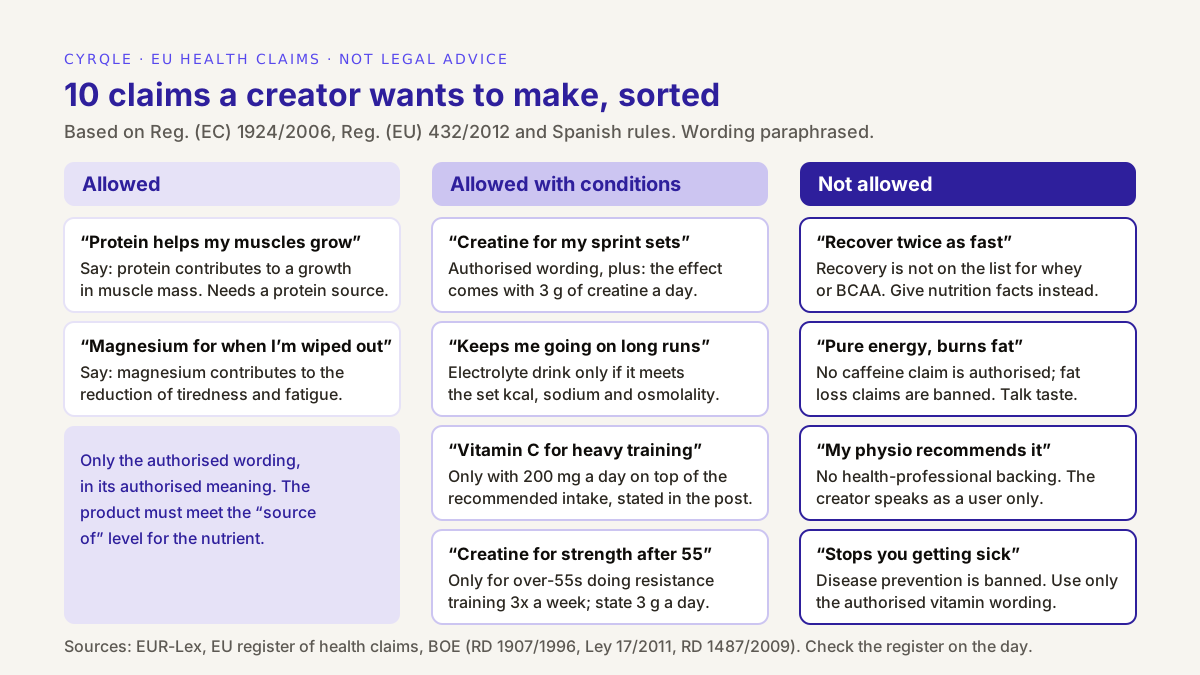
| # | What the creator wants to say | Group | Basis | What to brief instead |
|---|---|---|---|---|
| 1 | "Protein helps my muscles grow" | Allowed | Reg. 432/2012, protein | "Protein contributes to a growth in muscle mass." The product must be at least a "source of protein" under the Annex to Reg. 1924/2006 |
| 2 | "Magnesium for when I'm wiped out" | Allowed | Reg. 432/2012, magnesium | "Magnesium contributes to the reduction of tiredness and fatigue." The product must be at least a "source of magnesium" |
| 3 | "Creatine for my sprint sets" | With conditions | Reg. 432/2012, creatine | "Creatine increases physical performance in successive bursts of short-term, high intensity exercise." Only for products giving 3 g a day, and the post must say the effect comes with 3 g a day |
| 4 | "Keeps me going on long runs" (electrolyte drink) | With conditions | Reg. 432/2012, carbohydrate-electrolyte solutions | "Contribute to the maintenance of endurance performance during prolonged endurance exercise." Only if the drink meets the set formula: 80-350 kcal per litre from carbohydrates, sodium 20-50 mmol per litre, osmolality 200-330 mOsm/kg, among others |
| 5 | "Vitamin C for heavy training weeks" | With conditions | Reg. 432/2012, vitamin C | "Vitamin C contributes to maintain the normal function of the immune system during and after intense physical exercise." Only with 200 mg a day on top of the recommended daily intake, and the post says so |
| 6 | "Creatine for strength after 55" | With conditions | Reg. (EU) 2017/672 | Only for adults over 55 doing regular resistance training; the post states 3 g a day, with training at least three times a week for several weeks |
| 7 | "Recover twice as fast" (whey, BCAA) | Not allowed | No authorised recovery claim for these substances | Nutrition facts and use: "my post-training shake, 25 g of protein per serving." No effect |
| 8 | "Pure energy, burns fat" (caffeine pre-workout) | Not allowed | No caffeine health claim is authorised; Art. 12(b) Reg. 1924/2006; RD 1907/1996 art. 4.2 | Taste, format, when you drink it. No energy, focus or fat-loss effect |
| 9 | "My physio recommends it" | Not allowed | Art. 12(c) Reg. 1924/2006; Ley 17/2011 art. 44.3; RD 1907/1996 arts. 4.7 and 5 | Remove the professional. The creator speaks as a user |
| 10 | "Stops you getting sick" | Not allowed | RD 1487/2009 art. 5.4; Reg. 1169/2011 art. 7.3 | Use only the authorised vitamin wording (row 5), with no illness |
The claims in rows 1 to 5 use the official English wording of the authorised entries. Check each one in the register before you brief, because amendments can change conditions.
Allowed with conditions: the condition goes into the post
A creator who uses the creatine claim without saying "3 g a day" is making the claim without the condition. This is the most common mistake with authorised claims, because creators shorten the wording to fit a reel. Put the condition into the brief as a required line, and make it part of the draft review. If the format is too short for the condition, for example a six-second clip, do not use the health claim in that format. Use it in the caption, the longer video or not at all.
The over-55 creatine claim is a good example of a claim that changes creator selection. It applies to adults over 55 doing resistance training. A 24-year-old powerlifter speaking to a 20-something audience is the wrong messenger for it.
The words that turn a claim illegal
Most unauthorised claims come from a small set of words. Ban them by name in the brief, because "no unauthorised claims" means nothing to a creator who has never read the register:
- Recovery, repair, "less soreness" for protein, BCAA, glutamine, HMB or carnitine.
- Burns, shreds, fat loss, "lose X kg in Y weeks", or any rate or amount of weight loss.
- Detox, cleanse, "flushes out toxins".
- Boosts immunity, "so you don't get sick", prevents injuries, anti-inflammatory, cures.
- Clinically proven, doctor-approved, recommended by nutritionists.
- "Natural" linked to an effect ("natural energy", "natural fat burner").
Botanicals (ashwagandha, ginseng, green tea extract) are a special case. Many botanical claims are "on hold" at EU level and can be used only under transitional rules. Do not brief a botanical claim without counsel.
What does Spain add on top of the EU list?
Spain adds three main texts. Real Decreto 1907/1996 governs advertising of products with a claimed health purpose, including products presented as useful for slimming or for changing your physical state. Ley 17/2011, the food safety and nutrition law, says in Article 44 that food advertising must comply "specifically" with RD 1907/1996. Real Decreto 1487/2009 regulates food supplements.
No health professionals, real or apparent
Three rules meet here. EU Article 12(c) bans claims that refer to the recommendations of individual health professionals. Ley 17/2011, Article 44.3(a), bans testimonials from health or scientific professionals, real or fictional, or from real or supposed patients, and "the suggestion of a health or scientific endorsement". RD 1907/1996, Article 5, prohibits health professionals from backing advertising of these products to the public, and extends this to anyone who appears to be a health professional without being one.
A December 2025 ruling shows how this plays out. The AUTOCONTROL advertising jury examined an Instagram post for a food supplement by an influencer who is a pharmacist and nutritionist, with claims such as "ideal para subir las defensas" (ideal to boost your defences). The jury found two problems. The post was covert advertising, because #publi appeared at the end of the caption and the creator's health profile made the commercial intent less clear. And the post broke Reg. 1924/2006, RD 1907/1996 and Ley 17/2011, because it used a health professional to promote the product (Uría Menéndez note on the ruling). The advertiser was not an AUTOCONTROL member, so the jury sent the ruling to the public administration.
No slimming, no disease
RD 1907/1996, Article 4.2, bans advertising that suggests specific slimming or anti-obesity properties. Article 4.4 bans promises of certain relief or cure. For food supplements, RD 1487/2009, Article 5.4, says labelling, presentation and advertising must not attribute to a supplement the property of preventing, treating or curing a human disease, "ni se referirá en absoluto a dichas propiedades" (or refer to such properties at all). Regulation (EU) 1169/2011, Article 7(3), says the same for all foods.
The grey zone: performance and well-known faces
Two lines in RD 1907/1996 look hard to square with creator marketing. Article 4.12 bans advertising that suggests the product improves physical, mental, sport or sexual performance. Article 4.7 bans testimonials from health professionals, "famous or publicly known people" or real or supposed patients as a way to drive consumption. Yet the EU list authorises a creatine performance claim, and a creator is publicly known by definition.
The EU regulations apply directly, and Ley 17/2011 says its testimonial rule applies "without prejudice to" Reg. 1924/2006. How a Spanish authority or the AUTOCONTROL jury would weigh these rules for a specific product and creator is a question for your lawyer, not for this article. The safe brief in practice:
- Use only authorised claims, word for word, with their conditions.
- Avoid personal health testimony: "it fixed my...", "since I take it I...". Let the creator describe use, taste and routine.
- Ask counsel how Article 4.7 applies to a large creator for your product before the campaign, not after the post.
Disclosure first
Every one of these posts is advertising, so the label comes first. AUTOCONTROL's influencer code, in force since October 2025, expects the label to be clear and immediate; the December 2025 ruling turned partly on #publi sitting at the end. If the creator meets the "user of special relevance" thresholds, Real Decreto 444/2024 adds registration and further duties. The problem is wide: in an EU sweep of 576 influencers published in February 2024, 97% posted commercial content but only 20% systematically disclosed it (European Commission sweeps page).
TikTok adds a platform rule. Its Branded Content Policy prohibits weight-loss and weight-management supplements in branded content, including fat-burning pills and appetite suppressants, and restricts vitamin supplements: over-18 audiences only in listed markets, explicit TikTok permission, and not allowed at all in other markets. Check the policy for your market before you brief a TikTok post.
How do you choose creators for a supplement campaign?
Choose creators who speak as users, not as clinicians. The rule of thumb: if the audience could read the post as health advice from a professional, the creator is the wrong fit for a health-claim campaign.
- No clinical titles in the post. Avoid creators who present as "Dr.", nutricionista, dietista-nutricionista, fisio, farmacéutica or "health coach" in their bio or handle, unless counsel clears a role that is not promotional. The December 2025 ruling involved exactly this profile.
- No clinical setting. No lab coats, clinic rooms, pharmacy counters, "prescribing" language or "my patients".
- Athletes as users, not authorities. A triathlete can show her race-day bottle. She should not explain what it does to her blood sugar.
- Check past posts. Read the creator's last few months of sponsored content. A creator who wrote "this cured my gut" for another brand will probably write it for you.
- Check the audience age. Ask the creator for a screenshot of the platform's audience age insights, especially on TikTok, where vitamin supplement content is restricted to adult audiences in markets where it is allowed.
Before/after content
Treat before/after images as claims. Under Article 2 of Reg. 1924/2006, a picture can imply an effect. Under Article 12(b), claims about the rate or amount of weight loss are banned. In Spain, RD 1907/1996 Article 4.2 bans slimming suggestions. TikTok prohibits weight-loss supplements in branded content. So brief them out: no before/after body images, no weight or measurement changes linked to the product. Training-progress content (a faster 10k, a heavier squat) is safer only when it does not attribute the progress to the product, and it still goes through review.
What must the brief contain?
The brief is where most claim problems are prevented. A creator cannot follow a rule nobody gave them. Use this as the minimum for a supplement or sports nutrition campaign:
Brief clause library
Copy these into the brief or the brand terms annex of the contract and edit them to fit. They are plain-language starting points, not drafted legal clauses; have your lawyer review the final text.
- Approved claims. "You may use only these health claims, word for word: [list]. You may describe the product's taste, format, ingredients and how you use it. Do not add any other health effect."
- Conditions. "If you use the creatine claim, you must also say that the beneficial effect is obtained with a daily intake of 3 g of creatine."
- Banned phrases. "Do not say, write or show that the product helps with recovery, fat loss, detox, immunity against illness or injury prevention, or that it is clinically proven or recommended by a doctor, nutritionist, physiotherapist or pharmacist."
- No clinical authority. "Do not present yourself as a health professional in this content, by title, clothing, setting or wording."
- Imagery. "Do not use before/after body images or show weight or measurement changes linked to the product."
- Disclosure. "Label every piece as advertising at the start, in Spanish ('#publicidad' or 'Publicidad'), and turn on the platform's paid-partnership label."
- Pre-approval. "Send every draft, including caption, voice-over and on-screen text, for written approval before publishing. Do not publish changes after approval without a new approval."
- Corrections. "If we ask you to correct or remove content for a claims or disclosure reason, do it within [24] hours."
- Comments and DMs. "Do not answer follower health questions with health claims. Reply that they should ask a health professional, or send them to the brand."
- Records. "Keep the published content and its date for [12] months, and send us a screenshot of every Story within 24 hours of posting."
How should the pre-publication review work?
Every draft goes through a person who checks it against the brief and the register before it is published. The review has five steps and one escalation.
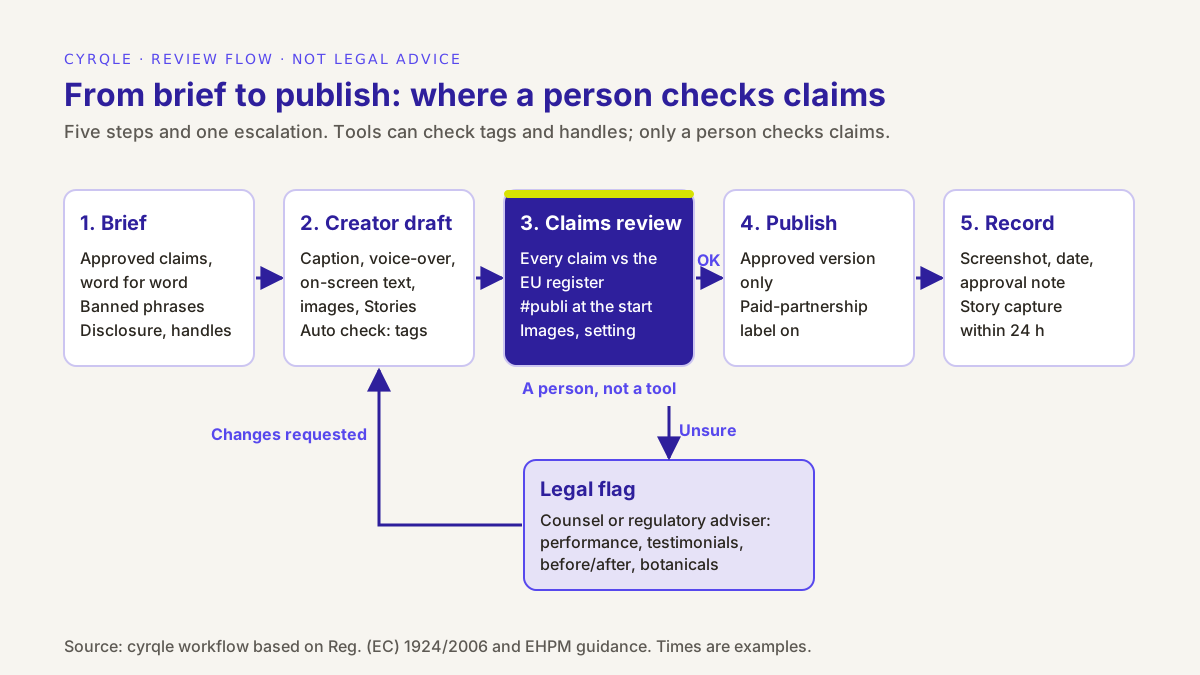
- Brief. As in the checklist above.
- Creator draft. Caption, script or voice-over, on-screen text and images. Stories and lives need a script, because you cannot review them after they disappear.
- Claims review. A named person on the brand side reads every claim and compares it with the register entry and the brief. They also check that the label is at the start, that conditions are present, and that the setting and imagery do not imply clinical authority or a body transformation. Their decision is approve, request changes or flag.
- Legal flag. Anything the reviewer is unsure about goes to counsel or a regulatory adviser: performance messages, testimonials, before/after content, botanicals, a new claim the creator proposes. Changes go back to the creator, and the new draft returns to step 3.
- Publish and record. The creator publishes only the approved version. Keep the approved draft, the reviewer's note, the publication date and screenshots, including Stories. This record is what you show if a complaint arrives, and it is the base of a compliance audit of a creator campaign.
The third step matters most. A draft approval without a person who knows the register only proves that someone pressed a button. For why the brand carries this risk even when the creator wrote the words, see brand liability for creator posts in Spain.
Worked example: fixing the Bilbao draft
Back to the CrossFit coach. The draft and the fix are illustrative.
| Draft line | Problem | Approved version |
|---|---|---|
| "I recover twice as fast since I started taking it" | No authorised recovery claim; quantified effect; personal health testimony | "Creatine increases physical performance in successive bursts of short-term, high intensity exercise. The effect comes with 3 g a day." |
| "My physio swears by it" | Health-professional recommendation | Removed |
| "#publi" in the last line | Label at the end | "#publicidad" in the first line, plus the paid-partnership label |
| Before/after of his back in week 1 and week 8 | Implied body transformation | Replaced with a sprint-interval session on the rower |
The approved post is less punchy. It is also the one you can defend.
How this runs in cyrqle
cyrqle runs the brief, contract, draft and post steps in one place. The claims check stays with a person on your team.
- Brief. In Campaigns, you write the approved claims, conditions and banned phrases on the Brief tab, with the required disclosure, handles and hashtags.
- Contract. Both sides e-sign the Creator Collaboration Agreement. You can link your brand terms, which is where the pre-approval, correction and records clauses live. The terms are frozen at signature, with the IP address, device and time recorded.
- Draft sign-off. Turn on draft sign-off for the campaign. An automated check shows chips for required elements: the disclosure tag for the market (for Spain it looks for #publicidad or #ad), the brand handle and the campaign hashtag. A missing disclosure tag shows as a red flag. A person then reads every claim and checks where the label sits, and chooses Approve or requests changes.
- Posts. Published Instagram and TikTok posts are tracked, and the same tag check runs on the live caption. Stories are not tracked automatically, so keep screenshots.
- Record. The Campaign report (PDF or CSV) keeps drafts and posts together for an audit.
Two limits to state plainly. The check reads tags and handles; it does not read claims. And it flags a missing tag; it does not stop anyone from approving a draft. Before you invite a creator, use the creator profile in Find creators to read their bio and past brand collaborations for clinical titles or old disease claims.
For the commercial side of creator marketing for this category, see creator campaigns for fitness and supplement brands. For the other regulated categories, go back to the regulated-products matrix.
FAQ
Can an influencer say a protein powder helps build muscle?
Yes, with the authorised wording: "Protein contributes to a growth in muscle mass." The product must be at least a source of protein under the Annex to Reg. 1924/2006. "Builds muscle fast" or "doubles your gains" goes beyond the authorised meaning, so keep the creator close to the register wording.
Can a nutritionist or physiotherapist promote a supplement on Instagram in Spain?
Not as a health professional recommending it. EU Article 12(c), Ley 17/2011 Article 44.3(a) and RD 1907/1996 Article 5 all ban this, and in December 2025 the AUTOCONTROL jury ruled against a supplement post by a pharmacist-nutritionist influencer. If you want to work with a creator who has a health qualification in any other role, ask your lawyer first.
Are before-and-after photos allowed for supplements?
Treat them as not allowed. A picture can be a claim, weight-loss rate and amount claims are banned in the EU, slimming suggestions are banned in Spain, and TikTok prohibits weight-loss supplements in branded content. Brief them out and review the imagery in every draft.
What can a creator say about caffeine or a pre-workout?
No caffeine health claim is authorised in the EU, so the creator should describe the product, the taste and when they use it, not energy, focus, endurance or fat burning. If the pre-workout contains an ingredient with an authorised claim, such as creatine at 3 g a day, that claim can be used with its condition. Check the register on the day you brief.
Is the brand responsible if the creator adds a claim the brief did not include?
In practice, usually yes, because the content advertises your product. That is why the brief bans phrases by name, the contract requires pre-approval and quick corrections, and a person reviews every draft. Keep the record of what you approved and what you asked to change.
Do these rules apply to Stories and live streams?
Yes. The rules apply to any commercial communication, whatever the format. Ask for a script before a Story or live, and ask the creator to send screenshots, because Stories disappear and are hard to evidence later.
Sources
- Regulation (EC) 1924/2006 on nutrition and health claims (Articles 1, 2, 10, 12): EUR-Lex
- Regulation (EU) 432/2012, list of permitted health claims: EUR-Lex
- Regulation (EU) 2017/672, creatine claim for adults over 55: DOUE copy on boe.es
- Regulation (EU) 1169/2011, food information to consumers (Article 7): EUR-Lex
- EU Register of nutrition and health claims: European Commission
- AESAN, list of authorised health claims and amending regulations: aesan.gob.es
- Real Decreto 1907/1996, advertising of products with a claimed health purpose (Articles 4 and 5): BOE-A-1996-18085
- Ley 17/2011, food safety and nutrition (Article 44): BOE-A-2011-11604
- Real Decreto 1487/2009, food supplements (Article 5): BOE-A-2009-16109
- Uría Menéndez, note on the AUTOCONTROL ruling of 12 December 2025: uria.com
- Ministerio de Consumo, sports supplements labelling note, June 2021: lamoncloa.gob.es
- Hernández Rodríguez, doctoral thesis on sports supplement claims, Universidad de Murcia, 2025: portalinvestigacion.um.es
- TikTok Branded Content Policy: tiktok.com
- European Commission, consumer protection sweeps (influencer sweep, February 2024): commission.europa.eu
- NutraIngredients, "EHPM launches new influencer marketing guidelines", June 2026: nutraingredients.com
Related field notes.
A public post is not a licence. What brands in Spain, the EU and Latin America need before they reuse customer and creator content: copyright, image rights, GDPR, clear usage terms and a record you can prove.
Brand liability for influencer posts in Spain: how hidden ads and misleading claims are shared with the creator, and what to put in the brief and contract.
An influencer campaign compliance checklist for agencies: the six records to keep for every post, from signed contract to payout, and how to audit them fast.