
Creator contract red flags: a clause-by-clause read before you sign
Influencer contract red flags, clause by clause: perpetual rights, open exclusivity, endless revisions, slow pay, unpriced ads. A fair counter for each.
An influencer contract red flag is a clause that moves money, time or control from you to the brand without a price or a limit. The usual eight are: perpetual or worldwide usage, open-ended exclusivity, unlimited revisions, payment only when the brand is "satisfied", payment terms beyond 60 days, paid-ads use folded into an organic fee, a morality clause with no definitions, and an assignment of your name, image and voice. Each one has a fair counter-wording you can send back before you sign.
Picture a lifestyle creator in Valencia with 30,000 followers. A skincare brand sends a six-page PDF the night before filming. The fee is EUR 1,200, and the email says "it's our standard contract, please sign today". This guide is for that night. It shows one mock contract with the eight clauses highlighted, then takes each clause in turn: what it says, why it costs you, what to ask for instead, and when to put a price on it. It is written for creators in Spain first, with notes for Mexico. It complements the creator's guide to brand deals, which covers pricing and getting paid.
Is it an abusive clause, or just a bad deal?
A one-sided clause in an influencer contract is usually a bad deal, not an "abusive clause" in the legal sense. In Spanish law, the abusive-clause rules protect consumers (TRLGDCU, articles 3 and 82), and a consumer is someone acting outside their trade or profession. A creator who invoices a brand acts as a professional, so a court will not strike a clause just because it is unfair to you.
You still have tools. The ones that matter most for creators are:
- Civil Code, article 1256. "La validez y el cumplimiento de los contratos no pueden dejarse al arbitrio de uno de los contratantes": performance cannot be left to the will of one party (Código Civil). Article 1115 makes a condition that depends only on the debtor's will void.
- Late-payment law, Ley 3/2004. 30 days by default, never more than 60, statutory interest and EUR 40 collection costs. Article 9 voids a payment-term clause that is manifestly abusive to the creditor, which is the one place where "abusive" applies between businesses (BOE-A-2004-21830).
- Copyright law (LPI), articles 43, 45, 47 and 48 bis. A licence covers only the uses it names; no term means five years; future works cannot be assigned in bulk; a manifestly disproportionate lump sum can be revised (BOE-A-1996-8930).
- Image-rights law, LO 1/1982. Your right to your own image cannot be waived or sold, and consent to use it can be revoked (BOE-A-1982-11196).
These are a floor, not a plan. Using them means a dispute. Fixing the clause before you sign costs one email. "Standard contract" is a negotiating position, not a rule: careful brands expect a redline.
The annotated contract
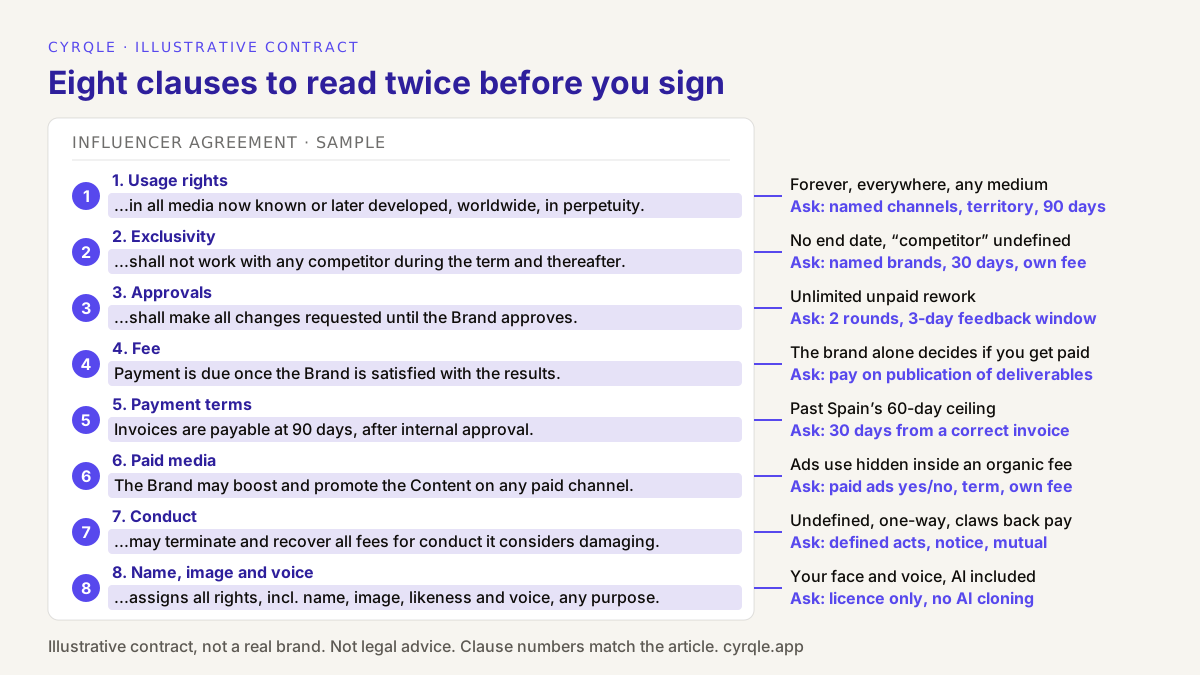
Read the mock contract from top to bottom. Each highlighted phrase is the part of the clause that does the damage; the margin note says what it costs and what to ask for. The wording is a composite of clauses that appear in real creator contracts, and the sections below use the same numbers.
The eight red flags, clause by clause
The counter-wordings below use the same vocabulary as the brand-side influencer contract template for Spain (Creator, Brand, Content, Deliverables), so a brand's lawyer will recognise them. Fill the brackets with your own numbers.
1. Perpetual or worldwide usage
What it says.
The Brand may use the Content in all media now known or later developed,
worldwide, in perpetuity.
Why it costs you. Your video keeps working for the brand for years, in markets you never priced, with your face on it. A perpetual licence is a buyout: you are paid once for every future use. Spanish law reads licences narrowly: a transfer covers only the uses it names, lasts five years when no term is stated and covers only the country where it was granted when no territory is stated (LPI art. 43.2). It does not reach media that did not exist at signing (art. 43.5). In Mexico, a transfer with no stated term is deemed to last five years, and more than 15 years is allowed only exceptionally (LFDA, art. 33); check with a local adviser. But "in perpetuity" is a stated term, so the default does not help you once you sign it.
Ask for this instead.
The Creator grants the Brand a non-exclusive licence to use the Content on
[the Brand's Instagram and TikTok accounts and its website] in [Spain] for
[90] days from first publication. Any other use, channel, territory or a
longer term requires a written amendment and an additional fee.
Put a price on it. Every licence needs a usage rights term in days. If the brand really wants a buyout, quote it as one. The usage rights and exclusivity calculator shows illustrative uplifts by scope and term.
2. Open-ended exclusivity
What it says.
The Creator shall not work with any competitor of the Brand during the term
of this Agreement and thereafter.
Why it costs you. "Any competitor" is undefined and "thereafter" has no end, so one EUR 1,200 deal can block a whole category of income. Spanish copyright law voids a promise not to create any future work (LPI art. 43.4), but a promise not to promote competitors is a different thing and is generally valid. So the scope is what you negotiate. An exclusivity clause should name who, where, on which platforms and until when.
Ask for this instead.
From the signing date until [30] days after the last Deliverable is
published, the Creator will not publish paid content for [Brand X, Brand Y,
Brand Z] on [Instagram and TikTok] in [Spain]. The Brand pays an
exclusivity fee of EUR [amount], shown as a separate line on the invoice.
Put a price on it. Exclusivity is income you give up, so it is always a separate line. A short list of named brands costs the brand less than a whole category, which gives both sides a reason to narrow it.
3. Unlimited revisions
What it says.
The Creator shall make all changes requested by the Brand until the Brand
approves the Content.
Why it costs you. This is unpaid work with no end, and it can also delay your payment if payment is tied to approval (see red flag 4). A good draft approval process has a limit on rounds and a deadline for feedback.
Ask for this instead.
The fee includes [2] rounds of revisions, requested in writing within [3]
business days of each draft. A draft with no comments by then is approved.
Further rounds or a reshoot cost EUR [amount] each. Correcting a factual
error or a missing disclosure label is not a revision round.
Put a price on it. Two rounds is common practice, not law. A reshoot is a new day of work, so quote it like one.
4. Payment on "brand satisfaction"
What it says.
Payment is due once the Brand is satisfied with the results of the campaign.Why it costs you. The brand alone decides whether you get paid, and "results" can mean sales you do not control. Under the Spanish Civil Code, performance of a contract cannot be left to the will of one party (art. 1256), and a condition that depends only on the debtor's will is void (art. 1115). You could argue the clause away in court, but a court case for EUR 1,200 is not a plan. A real commission deal is different: there, a sales-based fee is fine if the brand gives you a statement you can check.
Ask for this instead.
The Brand pays [50]% of the fee on signature and [50]% on publication of
all Deliverables listed in Annex 1. Payment does not depend on campaign
results.
Put a price on it. If the brand wants performance pay, agree a fixed base plus a commission with a tracking link or code and a monthly statement.
5. Payment terms beyond 60 days
What it says.
Invoices are payable 90 days end of month, after completion of the Brand's
internal approval process.
Why it costs you. In Spain, a business that buys a service must pay within 30 calendar days of receiving it if the contract sets no date. An acceptance or check procedure can last at most 30 days. The parties can agree a longer term, but never more than 60 calendar days (Ley 3/2004, art. 4). The law treats you as a business here, because it covers self-employed professionals. Late payments earn interest at the ECB rate plus 8 points (art. 7), which is 10.40% for the second half of 2026 (BOE-A-2026-14327), plus a fixed EUR 40 for collection costs (art. 8). A clause that excludes late interest or the EUR 40 is void (art. 9). If the brand is abroad, check the governing-law clause, because these rules may not apply.
Ask for this instead.
The Brand pays within 30 days of receiving a correct invoice. Late payments
accrue the statutory interest and the EUR 40 compensation for collection
costs under Ley 3/2004.
Put a price on it. Use the calculator below to see what a late payment costs the brand. The number is often small, but writing it into the contract tells the brand you know the rule.
Statutory late interest under Ley 3/2004 plus the fixed EUR 40 collection costs.
Illustrative defaults. Ley 3/2004, arts. 7 and 8. The rate changes each half year. Not legal advice.
Worked example (illustrative): a EUR 1,200 invoice paid 45 days late earns EUR 15.39 of interest (1,200 x 10.40% x 45 / 365) plus EUR 40, so EUR 55.39 on top of the fee. A EUR 3,000 invoice paid 120 days late earns EUR 102.58 plus EUR 40.
6. Paid-ads use that is not priced
What it says.
The Brand may use, boost and promote the Content on any paid channel.This line often sits inside a fee that was quoted for one organic post.
Why it costs you. Paid use buys reach you never had, to people who never chose to follow you, with your face on it. It is worth more than organic use at every term. Platform tools also have their own clocks: on TikTok, the creator chooses how long a Spark Ads authorisation lasts (7, 30, 60 or 365 days, per TikTok's help page). On Instagram, partnership ads run on an ad code or a permission you grant, and switching it off may not stop ads already running; check Instagram's current help page. The contract needs its own end date for paid use. Ads run from your own handle, often called whitelisting, need even tighter terms.
Ask for this instead.
Paid advertising: [YES / NO]. If YES, the Brand may use the Content in paid
ads from [the Brand's ad accounts / the Creator's handle via a partnership
or Spark code] in [Spain] for [30] days from the first ad. Any Spark or
partnership code is set to the same term. Paid use costs EUR [amount],
invoiced separately.
Put a price on it. Paid ads are usually the largest rights line. See what a usable UGC licence states in the EU for why paid use must be explicit.
7. A morality clause without definitions
What it says.
The Brand may terminate this Agreement immediately and recover all fees paid
if the Creator engages in conduct that the Brand considers damaging to its
reputation.
Why it costs you. "Conduct the Brand considers damaging" works as a cancellation at will plus a clawback of money you already earned. Morality clauses are legal, but one that depends only on the brand's opinion runs into the same Civil Code problem as red flag 4 (art. 1256). It is also one-way: if the brand is in a scandal, you are still tied to it.
Ask for this instead.
Either party may terminate on written notice if the other is convicted of a
crime, publishes hate speech, or breaches the advertising disclosure rules,
and does not cure the breach within [5] business days of notice. Fees for
Deliverables already published remain payable and are not refunded.
Put a price on it. Add a kill fee for cancellation without cause: a share of the fee if the brand cancels after you have started work. Many creators ask for 50%, which is common practice, not law.
8. Assignment of your face and voice
What it says.
The Creator assigns to the Brand all rights in the Content, including the
Creator's name, image, likeness and voice, for any purpose, including the
creation of derivative and synthetic works.
Why it costs you. This turns a licence into an ownership transfer and adds your identity to it, including AI copies. In Spain, the right to your own image cannot be waived or sold (LO 1/1982, art. 1.3), consent to use it can be revoked at any time (art. 2.3), and using a person's name, voice or image for advertising without consent is an unlawful intrusion (art. 7.6). Revoking consent can cost you compensation for the brand's justified expectations, so it is a last resort, not a clause to rely on. Your moral rights over the content, such as authorship and integrity, also stay with you (LPI art. 14). On AI, Spain's bill on honour, privacy and image, approved by the government in July 2026 and now in Congress, treats unauthorised use of a person's voice or image for advertising as unlawful (Ministry of Justice). It is a bill, not law yet. In Mexico, a person's portrait may be used only with their express consent (LFDA, art. 87).
Ask for this instead.
The Creator keeps ownership of the Content. The Creator authorises the use
of their name, image and voice only as they appear in the Content, for the
uses, term and territory set out in clause [1]. The Brand will not use the
Content to train AI models, clone the Creator's voice or likeness, or create
synthetic versions without separate written consent and a separate fee.
Put a price on it. If a brand wants your likeness beyond the content itself, for example a digital avatar, that is a separate contract with its own fee and term.
The red flags at a glance
| What it costs you | Ask for this instead | |
|---|---|---|
| 1. Perpetual or worldwide usage | Paid once for every future use, in every market | Named channels, named territory, 90 days, extra fee to extend |
| 2. Open-ended exclusivity | A whole category of income blocked, with no end | Named brands, platforms and market, 30 days after posting, own fee |
| 3. Unlimited revisions | Unpaid rework and a delayed payment | 2 rounds, 3-day feedback window, silence means approved |
| 4. Payment on brand satisfaction | The brand alone decides if you get paid | 50% on signature, 50% on publication of listed deliverables |
| 5. Payment beyond 60 days | Months of unpaid work, against Ley 3/2004 | 30 days from a correct invoice, statutory interest and EUR 40 |
| 6. Paid ads not priced | Ad reach bought at an organic price | Paid ads yes or no, term in days, separate fee, codes match term |
| 7. Undefined morality clause | Cancellation at will plus a clawback | Defined acts, notice and cure, mutual, published work stays paid |
| 8. Assignment of face and voice | Your identity used anywhere, AI copies included | You keep ownership; licence only; no AI training or cloning |
Before you sign: 10 questions
Run through these questions with the final PDF, not the email summary. A "no" is not always a reason to walk away, but it is always a reason to reply.
On tax: in Spain, a Spanish brand usually withholds IRPF from a professional creator's fee, so agree whether EUR 1,200 is before or after withholding and IVA.
What to do when the brand says "it's our standard contract"
Reply in writing, keep it short and propose wording instead of describing a problem. For example:
Thanks for sending the agreement. I am happy to go ahead with three changes:
clause 1 limited to your Instagram, TikTok and website in Spain for 90 days;
clause 4 paid 50% on signature and 50% on publication; and clause 5 at 30
days. Proposed wording is attached. If paid ads are planned, I can quote them
separately.
Three habits protect you:
- Do not film before both sides sign. A signed final PDF is the agreement. An email that says "we'll fix that later" is not.
- Check who signs and who pays. The contract should name the legal entity that owes you money. If the offer also looks odd in other ways, read how to spot a fake brand deal: a lopsided real deal and a scam can look alike at first.
- Know when to pay a lawyer. Exclusivity longer than 60 days, any buyout or perpetual licence, use of your likeness beyond the content, or a foreign governing-law clause are worth an hour of a lawyer's time before you sign.
How cyrqle helps
When a brand runs a campaign in cyrqle, the terms in this article are fields on the offer you see before you sign, not lines buried in a PDF. The Creator Collaboration Agreement shows the fee and deal type (Cash payment, Commission on every sale, Product gift or a mix), deliverables and timeline, the usage rights with duration and platforms, whether paid-ads use is granted, exclusivity (none, category or brand, with a number of days) and the number of revision rounds. A term the brand did not set reads "Not stated". Content-wall and campaign use are always part of the agreement; paid-ads use is included only when the brand ticks it on the offer, so you see it before you sign. A rights package can still be long or perpetual if the brand chooses that, so read it like any other contract.
Before you sign, you can counter the fee, deliverables, exclusivity and revision rounds. Once both sides e-sign, the agreed terms are saved as a frozen snapshot that the brand cannot change. The signing link works without an account, and the IP address, device and time are recorded. Signed agreements appear on your Agreements page with their status and a PDF. cyrqle does not review contracts or give legal advice. See compensation and contracts for how deals and payouts work, and cyrqle for creators to join the waitlist. The Creator plan is free.
More in this series
- How to get, price and get paid for brand deals as a creator in Spain and Latin America.
- The influencer contract template for Spain and the EU: the brand-side version, useful to see what a careful brand asks for.
- How to price usage rights and exclusivity as uplifts on the base fee.
- UGC rights in the EU: copyright, image rights and licence scope.
- How much to charge for a sponsored post on Instagram and TikTok.
FAQ
What are the biggest red flags in an influencer contract?
The biggest red flags are perpetual or worldwide usage, open-ended exclusivity, unlimited revisions, payment only when the brand is satisfied, payment terms beyond 60 days, paid-ads use with no separate fee, an undefined morality clause, and an assignment of your name, image and voice. Each one moves money or control to the brand without a limit or a price.
Can a brand use my content forever if I signed a contract?
Only if the contract says so. In Spain, a licence covers only the uses it names, and a licence with no stated term lasts five years. "In perpetuity" is a stated term, so it can bind you. Your consent to use your image can be withdrawn, but withdrawing can cost you compensation, so fix the term before you sign.
How long can a brand take to pay an influencer in Spain?
A Spanish business must pay within 30 days of receiving the service when the contract sets no date, and the parties cannot agree more than 60 days. Late payments earn the ECB rate plus 8 points (10.40% for the second half of 2026) and a fixed EUR 40 for collection costs, under Ley 3/2004.
Is a morality clause in an influencer contract legal?
Yes, a morality clause is legal, but a fair one defines the conduct, gives written notice and a chance to respond, works both ways, and keeps fees for published work paid. A clause that lets the brand end the deal and claw back fees because of anything it "considers damaging" is a red flag.
How many revisions should an influencer contract include?
Two rounds of revisions is common practice, not a legal rule. Put a feedback deadline on each draft, say that silence means approval, and price extra rounds and reshoots. Fixing a factual error or a missing advertising label should not count as a round.
Can I refuse to sign an exclusivity clause?
Yes. Exclusivity is a commercial term, so you can refuse it, narrow it or price it. Ask for named brands instead of "any competitor", a platform and market, an end date about 30 days after the last post, and an exclusivity fee as its own line on the invoice.
Sources
- Código Civil (arts. 1115, 1255 and 1256): BOE-A-1889-4763
- Ley 3/2004, late payment in commercial transactions (arts. 4, 7, 8 and 9): BOE-A-2004-21830
- Statutory late-payment interest, second half of 2026: BOE-A-2026-14327
- Ley de Propiedad Intelectual, RDLeg 1/1996 (arts. 14, 43, 45, 47 and 48 bis): BOE-A-1996-8930
- Ley Orgánica 1/1982, right to honour, privacy and one's own image (arts. 1, 2 and 7): BOE-A-1982-11196
- TRLGDCU, RDLeg 1/2007, consumer definition and abusive clauses (arts. 3 and 82): BOE-A-2007-20555
- Ministerio de Justicia, bill on honour, privacy and image (7 July 2026): mjusticia.gob.es
- Mexico, Ley Federal del Derecho de Autor (arts. 33 and 87): diputados.gob.mx
- TikTok Ads, how to create Spark Ads: ads.tiktok.com
Related field notes.
How much to pay for influencer usage rights: price each scope, term, territory and exclusivity window as an uplift on the base fee. Three worked euro examples.
How to get paid as a creator with Stripe Connect: what onboarding asks for and why, when a payout is scheduled and released, and how to read your statement.
An influencer whitelisting contract needs seven terms: permission scope, term, spend cap, creative approval, revocation, running ads at the end, data.